June 5, 2026
Categories:
EXTRA SAFE and Ava Labs Collaborate to Launch UGTP, Letting Stablecoins Pay Their Own Gas
A Chat Layer for the New Money
EXTRA SAFE, an encrypted messenger gaining traction in India, announced a collaboration with Ava Labs, the company dedicated to advancing the adoption and scalability of the Avalanche ecosystem. EXTRA SAFE is launching the Universal Gateway Transaction Platform (UGTP), the ERC-4337 paymaster infrastructure that enables stablecoins to pay gas fees on their own and offers a chain-agnostic experience, selecting Avalanche as its default blockchain.
The aim of the collaboration is a shared vision: to make tokenized dollars usable from day one and crypto infrastructure invisible to users.
EXTRA SAFE messenger users send ~180k messages a day, with daily message volume up 5.8x over the past five months on entirely organic adoption. The largest share of that traction comes from India, the world's number-one country in crypto adoption (Chainalysis) and the world's largest inbound remittance corridor, with $135 billion arriving from abroad every year (The Economic Times). UPI apps are widely used, but operate only domestically. For the country that needs cross-border the most, the rails are slow, expensive, and limited. EXTRA SAFE with Avalanche as the default blockchain closes that gap: nearly free, instant, available 24/7, cross-border, and gives users access to the global financial system.
Stablecoins Are Already Money
Stablecoins have already crossed into everyday use far beyond crypto trading. They are paying for groceries, rent, services, and ordinary commerce in places where reliable access to actual dollars is hard to come by. The clearest example is Tether's USD₮, the largest dollar-pegged stablecoin by circulation, increasingly chosen by people who simply want a stable store of value outside their local currency.
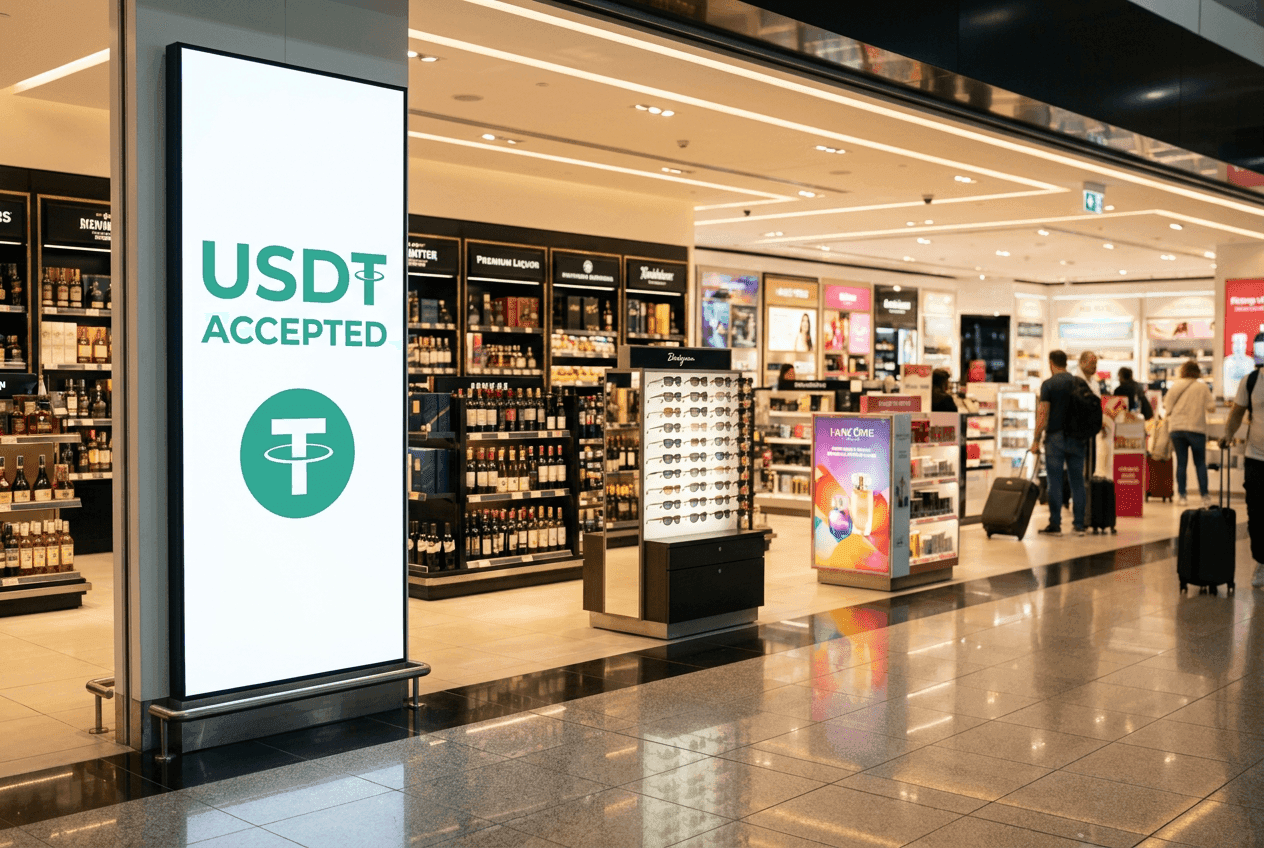
Francesco Ranieri Fabracci, Head of Tokenization Expansion at Tether, captured the picture in a post on LinkedIn in May, 2026:
“...a Bolivian duty-free shop pricing sunglasses and wine in USD₮...”
If a stablecoin can already replace the dollar in everyday transactions across 100+ countries, what happens when we reduce the barriers to entry and let that experience reach a much larger audience?
The Problem: People Lose Money to Move Money
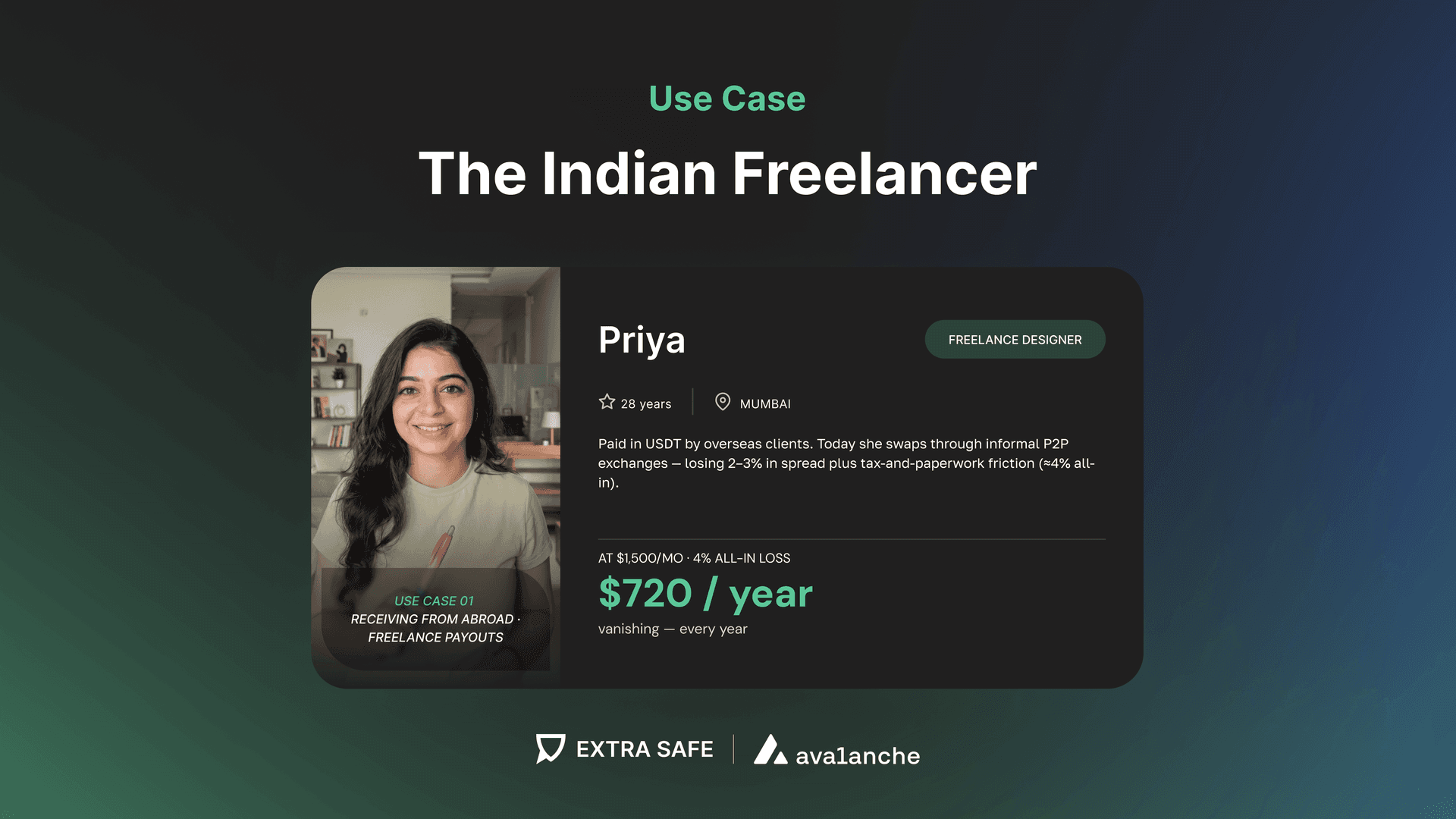
On-chain payments today are a tax on the people who need them most. A freelance designer in Mumbai who gets paid in USD₮ has plenty of ways to convert it into spendable rupees: centralized exchanges, P2P platforms, OTC desks. Every one of them charges: trading fees, withdrawal fees, FX spread. The all-in cost on a USD₮-to-INR conversion typically lands around 4%. At $1,500 a month, that is around $720 vanishing every year.
A software engineer in San Francisco sending $1,000 a month to his parents in India pays bank routes 3–6%, watches the FX rate get buried, and waits days for the funds to arrive. That is around $600 lost every year. All of this friction sits between people and the tokenized dollars they already hold.
Then the gas problem stacks on top. Anyone trying to move tokenized dollars on-chain today must first acquire a separate native token to cover gas fees. That detour adds friction at exactly the moment a user is trying to transact:
- •
A required pre-trade in a token the user did not want to hold, with another small loss in the swap.
- •
Wallet balances that cannot be fully spent because a gas reserve has to be kept in a different asset.
- •
Onboarding flows that break the moment a new user tries to send their first transaction.
This friction prevents the majority from stepping in and enjoying the benefits of this technology.
The Solution: The Universal Gateway Transaction Platform
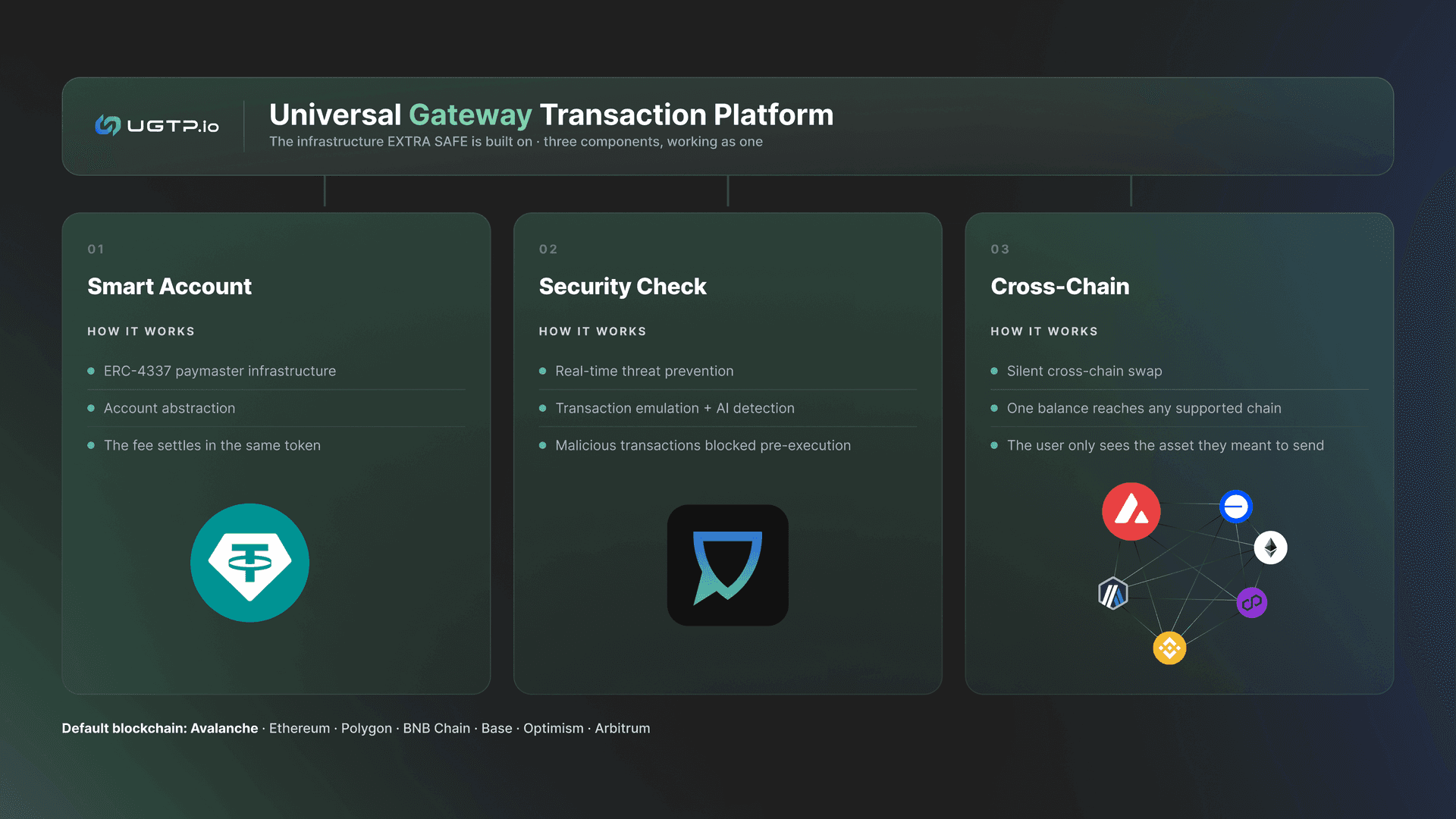
UGTP is the infrastructure that the EXTRA SAFE wallet runs on. It does three things at once:
1.
Lets stablecoins pay their own gas. Send tokenized dollars, pay gas in tokenized dollars, with no native token required — enabled by ERC-4337 paymaster infrastructure, the account-abstraction standard that lets the fee settle in the same token being sent. In plain terms: you hold USD₮, you send USD₮, and the network fee comes out of that same USD₮. The gas pays itself.
2.
Lets users send crypto they do not hold. The sender picks the token the recipient receives, and a cross-chain swap happens silently in the background. Either way, the user only sees the asset they meant to send — the routing and the swap run underneath, so one balance can reach anyone on any supported chain.
3.
Screens every transaction before it is signed. An independent, enterprise-grade threat-prevention layer emulates each transaction and runs it through real-time detection engines — reputation data and AI-driven behavioral analysis — blocking anything tied to phishing, poisoned or blacklisted addresses, fake tokens, or known exploit patterns before it ever reaches the chain. In plain terms: a firewall stands in front of every payment, so people can send money without having to spot the trap themselves. This is how security works on UGTP, the infrastructure EXTRA SAFE is built on.
Avalanche is the default blockchain because every transaction is confirmed in under a second, which means a payment in a chat lands at the speed of a message, in a 1:1 chat experience. Because Avalanche is EVM-compatible, UGTP connects naturally to the broader world of tokenized dollars users already hold. The EXTRA SAFE wallet ships with support across the leading EVM ecosystems: Avalanche, Ethereum, Polygon, BNB Chain, Base, Optimism, and Arbitrum, with Avalanche as the default.
The result is a self-custodial wallet that behaves like legacy money, with the advantages of the blockchain underneath. A new segment of users can step into the new form of money, save money every year on every transfer they make, and connect to the global financial system.
Embedded in a Self-Custodial Messenger
Chat and money belong in one app. They always have. Human experience and the financial system have lived together in everyday life for as long as both have existed, and the consumer surfaces that win the next decade are the ones that put them back together.
People send money to names, not to addresses. The Ethereum Name Service (ENS) proves it. According to the official ENS platform, the system has captured immense traction, securing over 1.6 million active names, nearly 800,000 unique wallet owners, and over 750 ecosystem integrations.
India proved it with UPI, where 22.64 billion transactions move between people in each other's contacts every month (The Hindu Business Line, April 2026). China scaled it with WeChat, where chat-as-payments runs at a civilizational scale: more than 1.41 billion transactions daily inside the same app where users live their conversations (CoinLaw, January 2026). The pattern is the answer to a question the rest of the world is still asking. UPI moves rupees inside India. WeChat moves yuan inside China. EXTRA SAFE moves tokenized dollars, anywhere, to anyone.
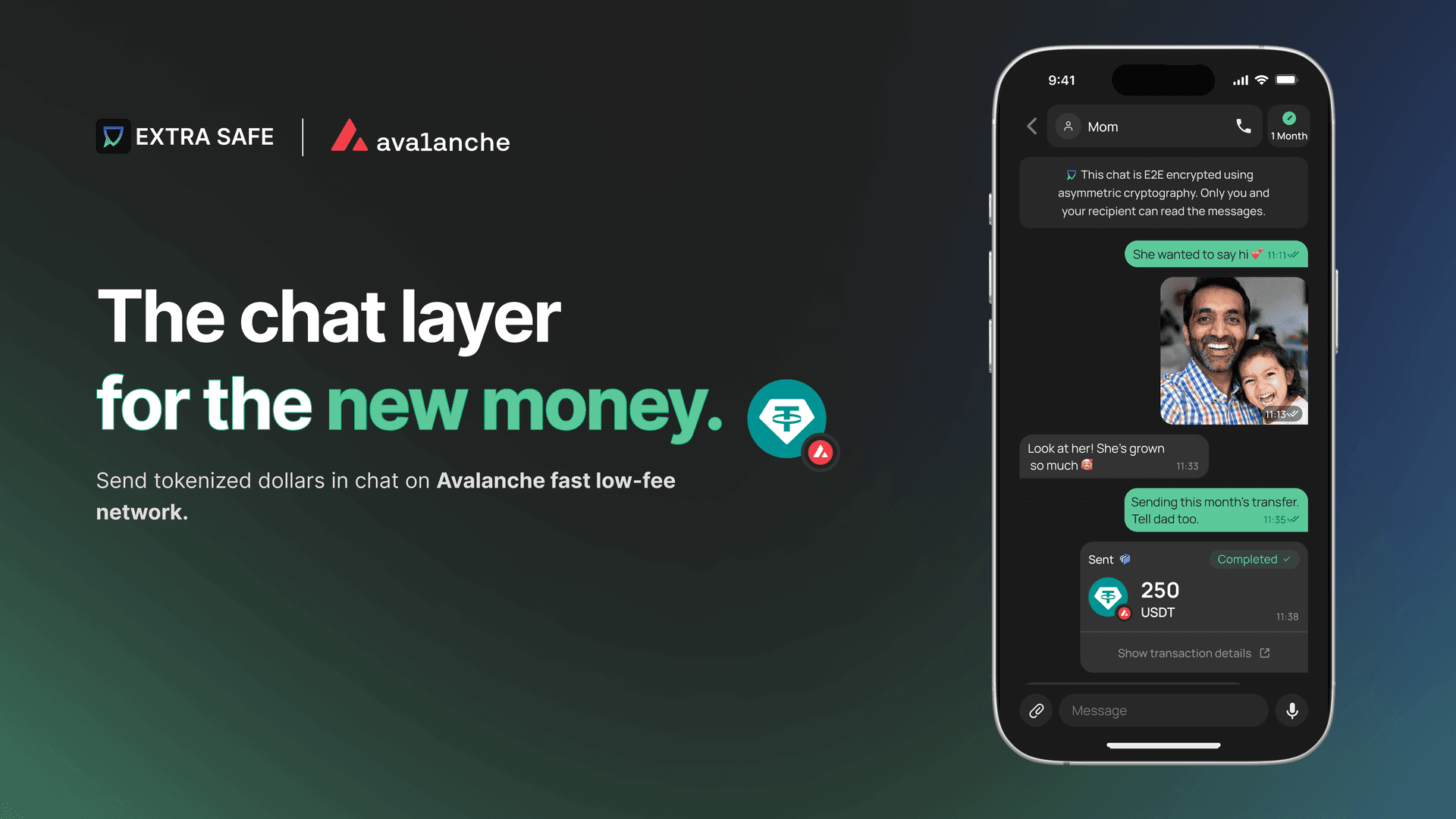
EXTRA SAFE is born to live inside the conversation, not next to it. The wallet sits where value naturally moves. Splitting a bill, paying a freelancer, sending a gift, settling a debt: these are conversational events, and EXTRA SAFE treats them that way.
With UGTP and Avalanche as the default blockchain, the wallet inside the chat:
- •
Lets users send tokenized dollars to anyone in their contacts — money moving at the speed of messages.
- •
Gives users a self-custodial infrastructure with the experience of legacy money.
- •
Charges gas in the token being sent, with no native crypto needed.
- •
Lets users send any crypto without holding it, removing the friction of swapping.
- •
Screens every transaction before it's signed — blocking phishing, scams, and malicious contracts before they reach the chain.
This is what the next generation of consumer finance looks like. EXTRA SAFE is building it now.
Why Avalanche
EXTRA SAFE chose Avalanche as the default blockchain because of what the network makes possible at the user level. Sending money inside a chat needs to feel like sending a message: nearly instant, almost free, available at every hour of every day. Avalanche delivers that at consumer scale, with the throughput to carry the volume coming out of India and the fee economics that let the paymaster underwrite gas in the token the user sent.
The collaboration runs deeper than infrastructure. Ava Labs and EXTRA SAFE share a bet: the next wave of users will arrive through everyday consumer surfaces, and the chains that win will be the ones that disappear inside those surfaces.
Looking Ahead
The closed beta opens in June 2026, with full production in July. Avalanche community members are invited to get early access.
JOIN THE BETA
The bet is simple: tokenized dollars become the way people send money, and the apps that put them where conversations already happen will define the category.
“Complexity was always the barrier, the price paid by everyone who learned self-custody the hard way. Money will move on-chain in the coming years, and that makes one thing necessary: the experience has to be similar to the money we’re all used to, with the advantages of the blockchain. With Avalanche as our default blockchain underneath, that is what we are building.” — Rita Urbach, Co-Founder, EXTRA SAFE
“Avalanche is positioned as the best place for building businesses on chain and in many ways this comes down to payments. Our team is thrilled to see payment builders establishing their product on our rails - it is exactly what we are looking for.” — Graham Friedman, Head of Emerging Tech and Infra, Ava Labs
About EXTRA SAFE
EXTRA SAFE is a flagship project by the Estonian software company Norionsoft OÜ, led by Israeli founders Alex Keselman, Shimon Peretz, and Rita Urbach. EXTRA SAFE is the chat layer for the new money.
About Avalanche
Avalanche is a technology platform built for business. Enterprises, financial institutions, consumer applications, and governments run business infrastructure on Avalanche because it is reliable, compliant, and fast enough for real financial infrastructure. BlackRock, Franklin Templeton, Apollo, FIFA, and the state of Wyoming trust the network.