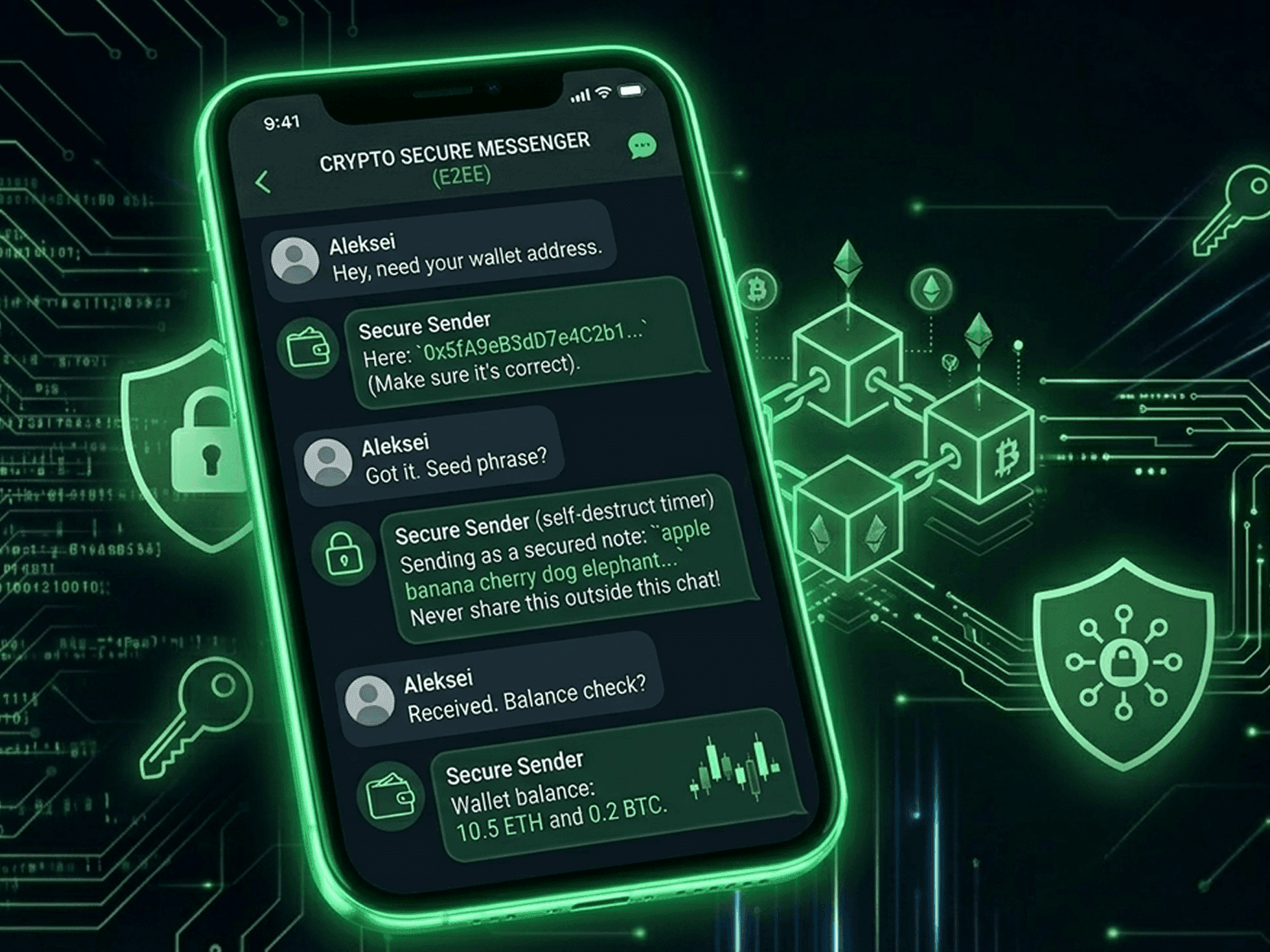
Crypto communication often happens in chat. Investors discuss positions, developers coordinate deployments, and friends send wallet addresses for quick transfers. At first glance, sending a message with an address or transaction hash might seem harmless. In reality, these conversations often contain sensitive data that can expose users to phishing attacks, impersonation, or financial loss.
Unlike traditional payments, blockchain transactions are irreversible. If a malicious actor intercepts or manipulates the information shared in a chat, the consequences can be immediate and permanent.
Understanding how messaging apps protect crypto-related conversations has therefore become a crucial part of Web3 security.
Why Crypto Conversations Need Extra Protection
Crypto users frequently exchange information that attackers actively search for. Examples include:
wallet addresses
transaction hashes
recovery instructions
seed phrase fragments
DeFi or exchange login details
investment discussions
Even something as simple as sending a wallet address can become risky. Attackers have been known to compromise accounts and replace addresses in messages with their own, redirecting funds without the sender realizing it.
There are also many examples of failed crypto communication.
A developer shares deployment keys in a regular messaging app, assuming the conversation is private. Later, the account is compromised through SIM-swap fraud, exposing the entire conversation history.
In another case, an investor sends a wallet address through a popular messenger. Malware running on a device replaces the copied address before the recipient pastes it into a transaction. The transfer goes to the attacker instead.
These situations demonstrate why crypto conversations require stronger protection than standard messaging.
What Makes a Messaging App Suitable for Crypto Communication
Secure messaging for crypto users depends on several architectural factors.
1.
End-to-end encryption ensures that messages are readable only by participants.
2.
Minimal metadata collection reduces the risk of communication patterns being exposed.
3.
Ephemeral messages allow sensitive information to disappear automatically after a short time.
4.
Decentralized or peer-to-peer communication removes central servers that could become surveillance or attack points.
5.
Identity protection helps users communicate without exposing phone numbers or personal identifiers.
For Web3 communities, the strongest messengers often align with the same cryptographic principles that secure blockchain networks themselves.
Messaging Apps Often Used for Crypto Communication
Different messaging platforms provide different levels of security and privacy. Some focus on encryption, while others prioritize convenience or large user networks.
Messenger | EXTRA SAFE | Telegram | Signal | Discord | |
|---|---|---|---|---|---|
Encryption | End-to-end, asymmetric encryption | End-to-end | Limited (Secret Chats) | End-to-end | Limited |
Identity Requirement | No phone or email, anonymous | Phone number | Phone number | Phone number | |
Ephemeral Chats | Native | Optional | Yes | Yes (optional) | No |
Privacy Level | Very High | Medium | Medium | High | Low |
Suitable for Crypto Communication | Excellent | Moderate | Moderate | Good | Weak |
Most mainstream messaging apps rely on phone numbers or centralized servers. While they offer encryption, they still collect metadata such as contact lists, timestamps, or IP information.
In crypto contexts, this data can expose relationships between investors, developers, or trading groups.
Privacy-first messengers designed around decentralized communication provide stronger protection for these scenarios.
EXTRA SAFE: Messaging Built for High-Security Conversations
EXTRA SAFE is designed around cryptographic identity rather than phone numbers or email accounts. Users connect using secure keys, similar to how blockchain wallets identify users on decentralized networks.
This architecture enables end-to-end encrypted communication where messages encrypt on user's device, stay encrypted in transfer, and decrypt only on the receiver's device. After the set time, the chat history auto-clears, so nothing is stored.
The special feature in EXTRA SAFE — P2P encrypted chat inside the calls session, where messages and files are transmitted directly between participants rather than through centralized servers.
For crypto users, this offers several advantages:
- •
Sensitive data such as wallet addresses or transaction details can be shared in conversations that automatically disappear after a defined time.
- •
Participants can communicate without exposing personal identifiers.
- •
Because the system is built on cryptographic identity, the communication model aligns naturally with Web3 environments where users are already accustomed to key-based authentication.
This makes the platform particularly suitable for developers coordinating deployments, investors discussing strategies, or anyone who wants their crypto conversations to remain private.
Why Secure Communication Matters in Web3
Crypto technology introduced a powerful idea: trust can be established through mathematics rather than centralized institutions.
However, the conversations surrounding crypto transactions often still happen in traditional messaging apps that were never designed for high-value digital assets.
As the Web3 ecosystem grows, protecting communication channels becomes just as important as protecting wallets themselves.
Secure messaging ensures that the information surrounding transactions — the human layer of blockchain — remains protected by the same level of cryptographic security as the networks users rely on.
Communicate About Crypto the Same Way You Secure It
Blockchain networks rely on strong cryptography to protect assets and transactions. The conversations surrounding those assets deserve the same level of protection.
If you regularly share wallet addresses, coordinate transactions, or discuss sensitive Web3 information, it makes sense to use a messenger designed for that environment.
EXTRA SAFE provides encrypted, peer-to-peer communication, a cryptographic identity instead of phone numbers, and ephemeral chats that reduce the risk of sensitive data exposure.
When crypto conversations matter, choose a communication channel built with the same security principles as the technology behind your assets.