August 20, 2026
Categories:
Can You Live Only on Crypto? A Reality Check, Category by Category
Could someone actually live on crypto alone, day to day, without ever touching a bank? The honest answer has less to do with which country you're in than with what you're trying to pay for — some parts of daily life have barely noticed crypto exists, while others have quietly built entire rails around it.
We mapped it out by category rather than assuming an answer going in. Some categories turned out stronger than expected. For others, adoption never made it past the announcement.
Salary: Getting Paid in Crypto Partly Works
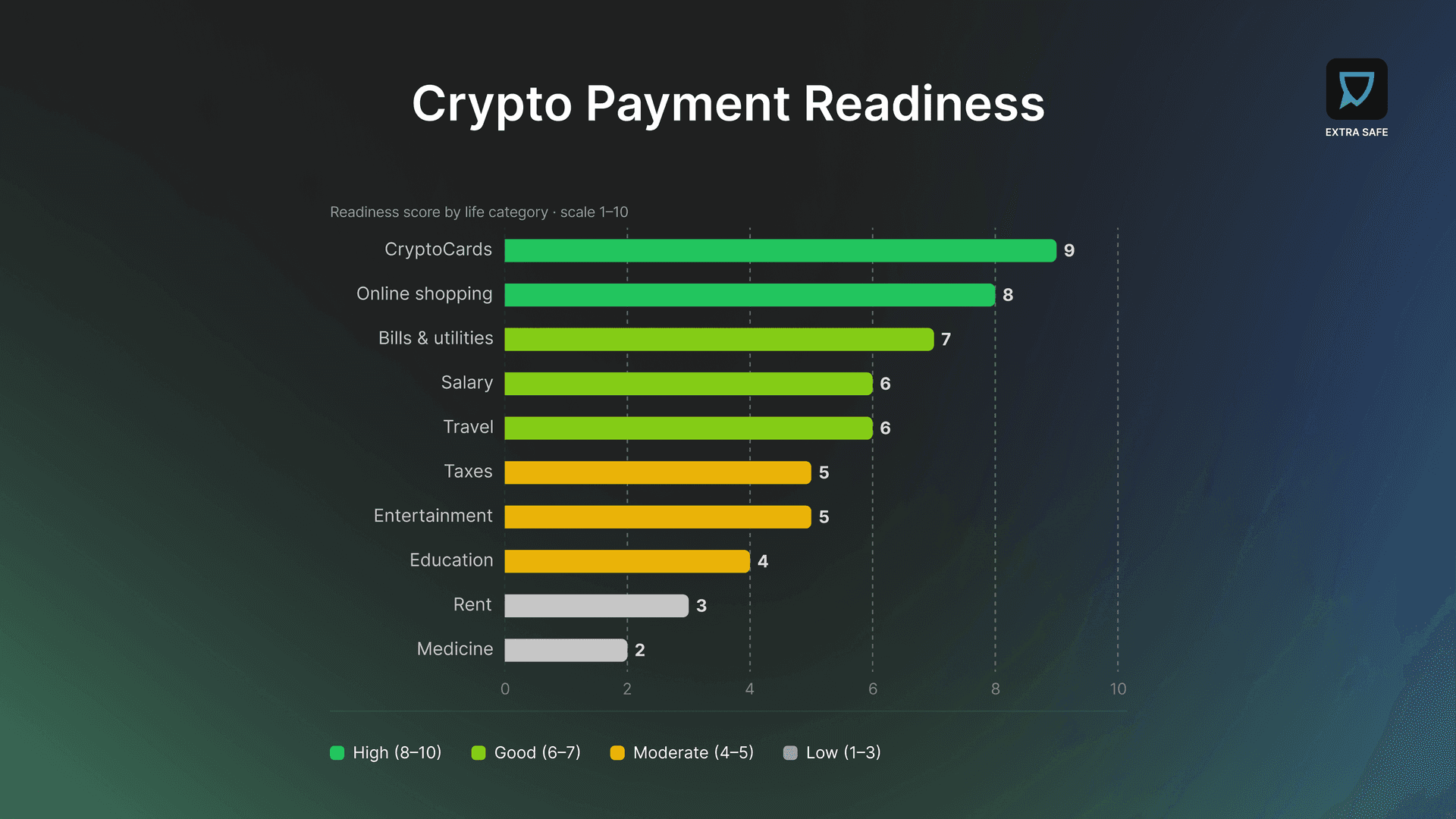
Salary sits in the middle of this list: adoption is real and growing fast, but it's still an opt-in extra, not a default paycheck option. Deel, a global payroll and HR platform used by employers in 150-plus countries, launched stablecoin salary payouts on Polygon in May 2026, allowing eligible employees in the US and Eurozone to receive part of their net pay in USDC, EURC, or USDT instead of a bank deposit. The platform already serves more than 40,000 business customers and has processed over $20 billion in global payroll. Bitwage, a crypto payroll service operating since 2014, has done something similar, paying more than 90,000 workers across 4,500 companies.
Behind a lot of this sits a layer most people never see. Rain, a B2B stablecoin card and payments platform that other companies build on, doesn't pay anyone directly. Instead, it gives companies like Western Union and Nuvei the infrastructure to make stablecoins spendable the moment they land, without a separate cash-out step first. Rain’s active card base grew 30 times over the past year alone. Getting paid in stablecoins is only half the story. Spending it is the other half, and that's where cards come back into this piece later.
Taxes: Already Real, Just Rare
Switzerland gives the clearest yes on this whole list. The city of Lugano accepts Bitcoin, Bitcoin on the Lightning Network, and USDT for every invoice it issues, including taxes, duties, and fines, with no cap on the amount. The canton of Zug has done the same since 2021. Neither is a pilot nor a promise. Both are live, official, and have been running for years.
Bills & Utilities: Mostly a Middleman
Bills are a partial yes, but almost always through someone standing in between the customer and the biller. Most utility companies don't take crypto directly. Instead, services like Zypto, a crypto bill-pay platform, sit in between, covering more than 87,000 billers across 120-plus countries and converting whatever crypto a customer sends into the currency the biller actually expects. TrustLinq, a Swiss-regulated payment bridge, runs a similar service for electricity, gas, water, and broadband bills.
One direct exception stands out. Blink Charging, a publicly traded US network of EV charging stations, began accepting USDC directly on-chain at select fast-charging stations in January 2026, with no conversion intermediary. The rollout started small, with just two locations in Florida, and plans to expand throughout the rest of the year.
Rent: The Weakest Link
Rent is where the gap between paying in crypto and someone actually receiving it shows up most clearly. RentRemote, a rent-payment service built for remote workers and digital nomads, which partnered with BitPay in July 2025, along with property-management platforms like Livly, ManageGo, and liv.rent, all do the same thing: a tenant sends crypto, a service converts it, and a landlord receives an ordinary bank deposit. None of these had a landlord accepting crypto directly into their own wallet at any real scale. The tenant may be paying in crypto. The landlord never sees it.
Medicine: Real, But Small
Medicine is the weakest category on this list. Hospital systems and health insurers haven't moved on this yet. What has moved, quietly, is a handful of independent dental and direct-pay practices. Desert Pearl Dentistry and Countryman Dentistry, two US dental clinics, list Bitcoin and Ethereum as payment options on their own websites. Wilson & Wilson Dentistry, a family dental practice in Michigan, uses a bitcoin-focused processor called Zaprite for the same purpose. The common thread: these are cash-based practices that don't bill insurance in the first place, which is exactly what makes taking crypto possible for them and not for almost anyone else in healthcare.
Education: Still the Exception
Education adoption is real but narrow — a handful of schools, not an industry-wide shift. Wharton, the business school at the University of Pennsylvania, became the first Ivy League institution to accept crypto for tuition back in 2021 — Bitcoin, Ethereum, and USDC, through Coinbase. The catch: it applied to exactly one six-week certificate course, not the MBA program or anything wider. Globally, an estimated 45 universities out of more than 25,000 accept crypto for tuition in some form, and over half of those are in a single country, El Salvador, where Bitcoin briefly held legal tender status.
Crypto Cards: The Workaround That Already Solved Half of This
Cards are the strongest category on this list, and for a simple reason: they don't need anyone else to adopt anything. Everything above eventually runs into the same wall: whoever is on the receiving end usually wants ordinary currency, not crypto. Cards sidestep that wall entirely, since the recipient never needs to know that the money started as crypto.
Crypto card spending hit $607 million in March 2026, up from $187 million a year earlier — six times the volume in eighteen months, with $6.5 billion spent cumulatively across more than 21 million transactions. A card converts stablecoins to fiat the moment a purchase is made, so it works across any of the categories above without needing that specific landlord, biller, or school to accept crypto directly.
Coinbase Card, the debit card tied to Coinbase's exchange accounts, has paused new applications in 2026, and BitPay Card, the older of the two, has been paused since 2023 while it changes banking partners — existing cardholders on both keep spending as usual, which says something about how fast this space is still shifting underneath its own products.
Food, Travel, and Everyday Shopping
These three move at different speeds, but all lean on patterns already covered earlier in this piece. Steak 'n Shake, the US fast-food chain, takes Bitcoin over the Lightning Network at every location, and AMC, the world's largest movie theater chain, does the same for tickets. Travala, a crypto-native travel booking platform[(https://www.travala.com), and [airBaltic, Latvia's national airline, accept crypto directly, though most "airline that takes crypto" stories are really travel agencies converting behind the scenes.
Online shopping got a lot easier in July 2025, when PayPal launched Pay with Crypto, letting any of its merchants accept over 100 cryptocurrencies while settling in ordinary dollars or PayPal's own stablecoin, PYUSD.
So, Can You Actually Do It?
Mostly, yes — but almost always with something standing in between. Almost everything on this list works because a processor sits quietly in the middle, converting crypto to fiat before it reaches the other side. That's not a workaround hiding a failure. It's the honest, current shape of the industry, and it's exactly why crypto cards, the one category built entirely around that conversion step, score highest of everything here.
What's Missing — and Where This Is Headed
Most of what actually works in this list works because a processor sits in the middle, quietly converting stablecoins to fiat before anyone downstream has to think about crypto at all. That's the honest state of things right now. But it also means the thing this piece keeps circling back to, a stablecoin moving directly from one person's wallet to another's, the way a message moves from one phone to another, is still the exception, not the rule.
Two gaps explain most of why. Direct wallet-to-wallet activity runs on public chains, where amounts and balances are visible to all, which is a real reason many people and businesses reach for a processor instead. And the person on the other end — a landlord, a dentist, a parent receiving a gift—usually has no wallet at all, so the sender needs a way to reach them regardless.
EXTRA SAFE is built around closing exactly those two gaps, inside a messenger people already use.
Tokenized dollars move directly inside a conversation, and the gas settles in the same tokens you send, so a transfer doesn't require holding a second asset just to cover a fee. Payment privacy is on the roadmap, so what moves between two people in a chat stays between them. And a Gift Link can bring someone with no wallet at all directly into a transfer, closing the gap that keeps many of the categories above running through a fiat conversion instead of going straight from one wallet to another.
The closed beta is running now, with the full release coming soon.
JOIN NOW →