November 20, 2025
One Cloudflare Glitch This Week Took Down Half The Internet — But It Didn’t Have To
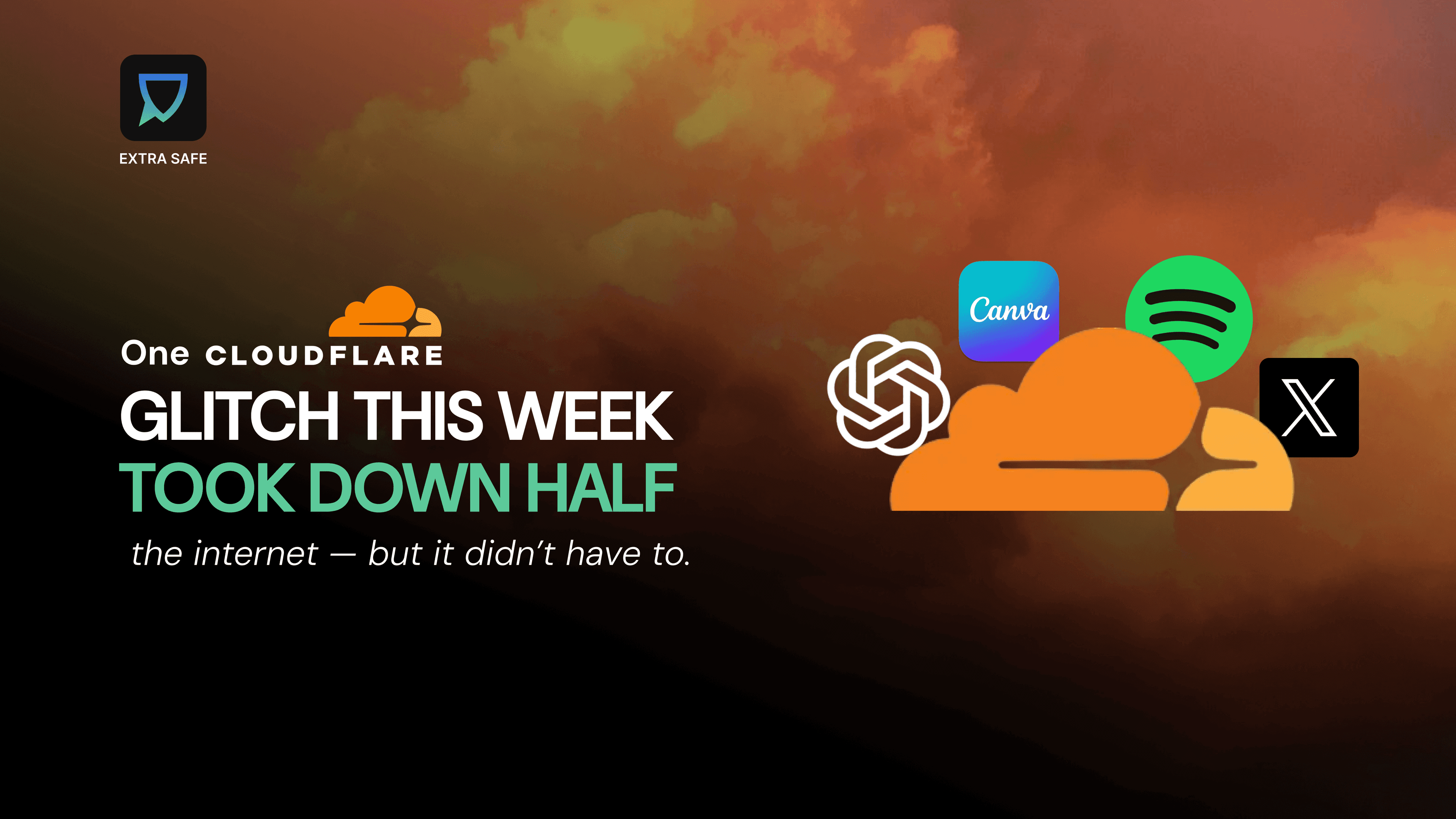
On 18 November 2025, a global Cloudflare outage disrupted access to social platforms from AI services and e-commerce sites, to public systems and crypto platforms around the world. Services including X (Twitter), ChatGPT, Spotify, Canva, League of Legends, Shopify, Dropbox, and Coinbase showed spikes of errors and downtime as traffic flowing through Cloudflare’s network started to fail.
While engineers were able to restore most services within a few hours, the disruption lasted long enough to affect public transit systems like New Jersey Transit and France’s SNCF railway, and the Moody’s credit ratings website, along with everyday online activity for organizations and users worldwide.
Anatomy of an Outage: What Went Wrong
Cloudflare sits between users and a huge number of websites as a kind of internet gatekeeper: it routes traffic, filters attacks, and accelerates content for a large slice of the web. When its edge layer works, requests quietly pass through, get checked, cached, and then reach the actual application.
On 18 November, that layer failed. Cloudflare later explained that an unusually large configuration file used to manage threat traffic triggered a software crash in its systems, which then showed up to users as a wave of HTTP 500 errors and timeouts on many different services.
Although this incident has been resolved, it raises a more pressing question: How much of the internet do we really want to route through a single, centralized infrastructure provider?
Why P2P Is a Strong Answer to Outages Like This
Peer-to-peer architecture comes from a different premise: the web should not rely on a small group of central infrastructure providers to remain accessible. When systems communicate directly across many independent nodes instead of routing through one company’s edge network, the impact of a single outage shrinks dramatically.
This is already evident in the cryptocurrency ecosystem. During a major Cloudflare outage in June 2022, several large centralized exchanges like FTX, Bitfinex, OKX, and others went down because their web front-ends depended on the same centralized infrastructure layer, while the underlying networks continued progressing independently.
The same core point applies to incidents like the November 18 Cloudflare outage. When access to services lives behind a small cluster of providers, one misconfiguration can affect large parts of the web at once. A P2P model reduces that concentration: control, routing, and availability are distributed across the network instead of centralized in one place, lowering the risk that a single provider’s bad minute becomes everyone’s bad day.
How EXTRA SAFE Puts P2P into Practice
EXTRA SAFE approaches communication as something that should exist independently. We are building the future of private communication on the same principle behind peer-to-peer (P2P) systems, where information moves directly between devices rather than through external control points.
In some cases, EXTRA SAFE might be affected in situations like this, but generally our P2P architecture gives strong benefits for those situations.
This structure creates a foundation that remains steadier when networks are unstable and private under heightened scrutiny.
True P2P exchange: Voice and video streams, along with screen sharing, travel directly between participants' devices, rather than through servers. EXTRA SAFE leverages WebRTC to enable peer-to-peer connections for real-time communication.
Asymmetric encryption: Each session is secured using a cryptographic key pair: a public key for establishing trust and a private key that remains on the user’s device. This model ensures that only the intended participants can decrypt content, and no intermediary can access or reproduce session data.
Anonymous identity model: Each account exists as a unique nine-digit EXTRA SAFE number, separate from names, emails, or phone numbers.
Ephemeral communication: Once the call ends (1:1 or group meeting), the chat history, along with all data related to the call, is automatically deleted.
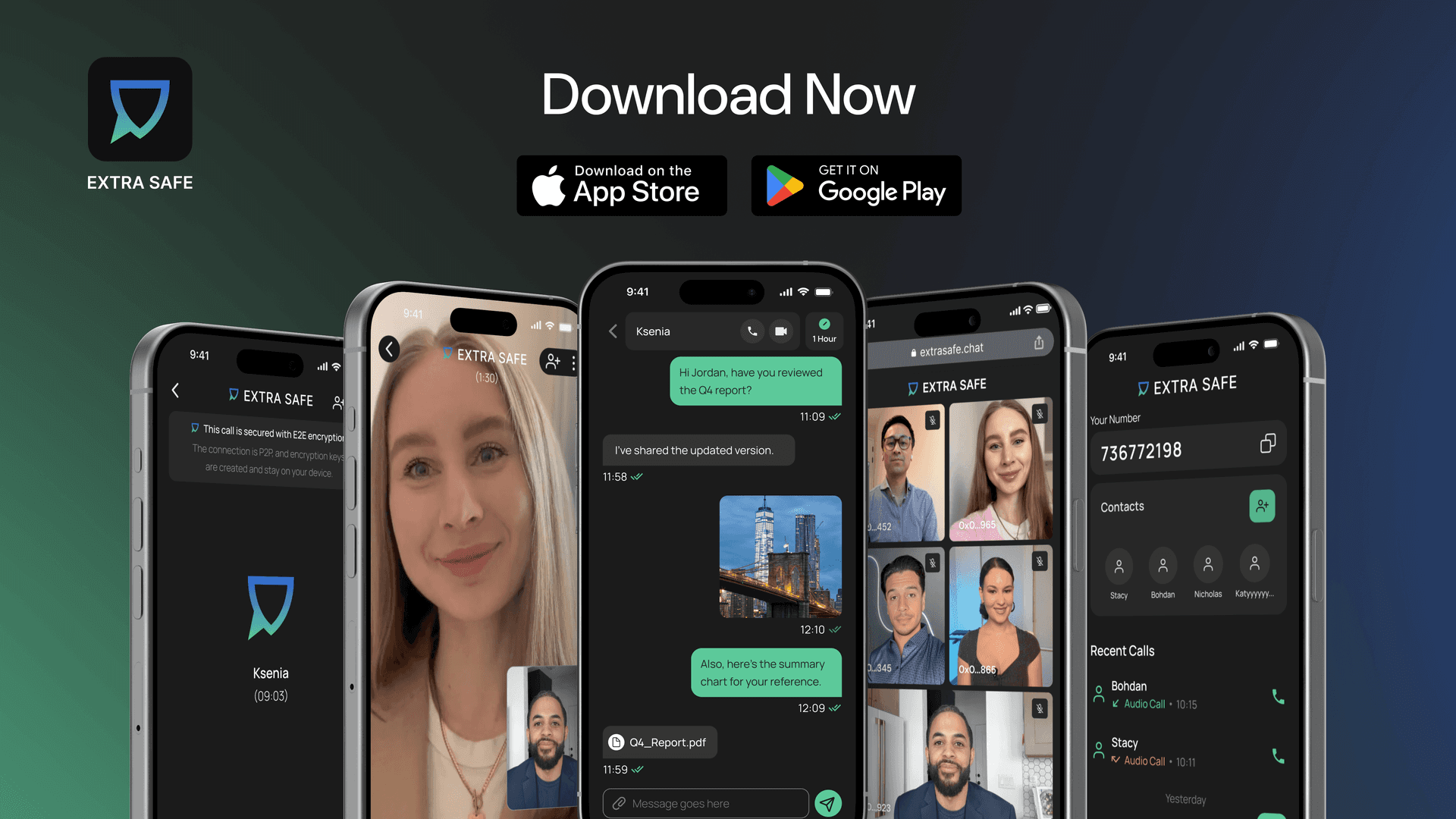
Download EXTRA SAFE app for free
Download the app for iOS and Android. Prefer desktop? Start a private meeting from your browser at extrasafe.chat