August 11, 2026
Categories:
10 Surprisingly Normal Things For Which You Can Pay with Crypto Today
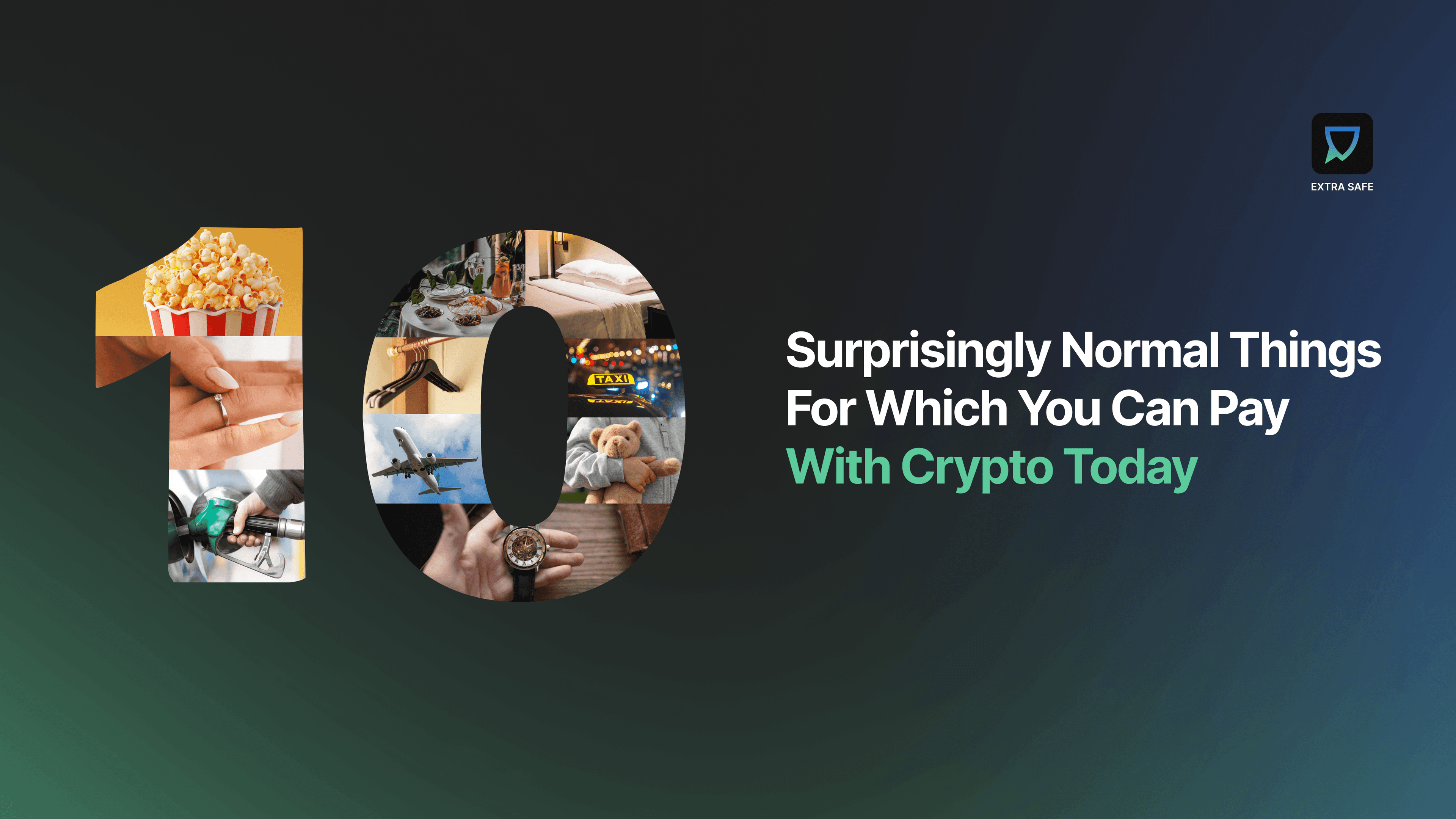
Where do people actually spend crypto? If you only know it from headlines, you might be surprised to learn it moved past trading, mining, and holding a while back, into everyday spending. Today, you can pay with it at the movies. At the gas pump. On a university's tuition page, right next to the wire transfer option. The places already taking it are more ordinary, and more spread out, than most people expect.
Hundreds of businesses now accept tokenized dollars or native coins instead of credit cards. Here are ten of the most interesting examples, all connected to daily life.
1. Fast Food & Coffee
Last year, the U.S. fast food chain Steak 'n Shake jumped right into the new payment option. It enabled Lightning Network payments at every US location in one day in May 2025. By that evening, one in every 500 Bitcoin transactions worldwide happened at a Steak 'n Shake register. The company even signed its launch announcement as "Steaktoshi" — a nod to Satoshi Nakamoto, Bitcoin's pseudonymous creator.
Same-store sales rose about 15% in the following months. That was enough for the chain to add a Bitcoin Steakburger to the menu and keep Bitcoin on its balance sheet. Win Win Coffee has a smaller version of this idea, rolling it out one counter at a time. As it turns out, crypto payments can move as fast as a drive-thru.
2. Gas & Convenience Stores
Sheetz has been a family-run road-trip chain since 1952, so it's not exactly a crypto-native brand. It quietly tested Bitcoin at a few Sheetz Cafe counters in 2021. Once that worked, it expanded to all 750-plus locations, adding Ether, Litecoin, and the stablecoin USDC as well.
New crypto users received $20 off their first purchase when the expansion launched. "We're excited to make digital currency payments available at all our stores," said EVP Ryan Sheetz. That's a pretty modern statement for a chain that's been around longer than the interstate highway system.
3. Movie Theaters
AMC didn't just quietly add a new checkout option. CEO Adam Aron made it an event, announcing on social media as each coin became available: Bitcoin, Ethereum, Bitcoin Cash, and Litecoin first in late 2021, then Dogecoin and Shiba Inu a few months later.
Within days of launch, crypto already accounted for 14% of AMC's total online transactions — a number Aron announced himself.
4. Electronics
Newegg has been accepting crypto longer than almost anyone else on this list. It started taking Bitcoin in 2014, making it one of the first major retailers to do so. Since then, it has kept breaking new ground: it was the first merchant to accept Dogecoin through BitPay in 2021, and then the first to accept Litecoin later that year.
Here's a number to consider: when Newegg expanded crypto checkout to 72 countries, the share of purchases made with crypto was nearly five times higher outside the US and Canada than within them.
Japanese Bic Camera, one of the country's largest electronics chains, was ahead of Newegg in crypto payments adoption. They tested Bitcoin at two Tokyo stores in April 2017. One of these was a hybrid outlet shared with Uniqlo.
After demand exceeded expectations, they rolled out Bitcoin payments nationwide within three months. Payments were processed through the exchange bitFlyer, with a cap of ¥100,000 (about $900) per transaction, and customers earned reward points just like with any other purchase.
5. Fashion
Ralph Lauren chose one store, the Miami Design District flagship, to launch its entire Web3 initiative: crypto checkout and an NFT collaboration with Poolsuite, both introduced at the same time. "It is one of the most Web3-friendly cities in the world," said David Lauren, the brand's chief innovation officer, explaining why they picked Miami.
Here's an interesting detail: if you return something you bought with crypto, Ralph Lauren refunds you in crypto as well, using the exchange rate on the day you bring it back, not the day you paid. So, crypto's volatility can work for or against you at the returns counter.
6. Flights & Hotels
Travel is the category where people want crypto payments the most. In a PayPal and National Cryptocurrency Association survey, 81% of travelers said they were interested in paying with crypto, the highest percentage of any industry surveyed. In fact, 89% said they would choose one airline over another just for the option.
airBaltic has accepted Bitcoin directly since 2014, making it one of the few airlines that doesn't use a payment mediator. Travala, which was built with crypto in mind from the start, saw its crypto booking volume grow by 46% year over year.
However, most other stories about airlines accepting crypto are actually about agencies like Alternative Airlines, which settle with the carrier in regular currency behind the scenes. Someone else does the converting, but you still get the same seat on the plane.
7. Luxury Retail
Hublot and TAG Heuer are both owned by LVMH, so when one added crypto payments in 2022, the other followed within weeks. It was almost like a company memo passed down the hall. TAG Heuer's CEO called it staying true to being an "avant-garde watchmaker."
Hublot launched a 200-piece limited-edition watch, available only through crypto checkout. Gucci took it a step further. It became the first retailer to accept ApeCoin, the token behind the Bored Ape Yacht Club NFTs. Today, Gucci accepts ten different cryptocurrencies and five stablecoins at its US stores.
8. Jewelry & Watches
Ace Jewelers, an Amsterdam dealer of Omega, Bulgari, and Breitling since 1975, became Europe's first high-end jeweler to accept Bitcoin in February 2016. This was years before most other names on this list did the same. "The time is right for the retail world to start embracing it," said co-CEO Alon Joseph at the time.
On a smaller scale, Chalmers Jewelers, which has two locations in Wisconsin, added Bitcoin, Ethereum, and Litecoin in 2021. This shows that crypto payments aren't just for flagship stores in big cities.
9. Sports Tickets & Merch
The Dallas Mavericks weren't the first NBA team to accept crypto. The Sacramento Kings did it back in 2014. But the Mavericks, supported by owner Mark Cuban's ongoing interest in crypto, became the first NBA team to accept Dogecoin in 2021, at a time when most of the league still avoided it. Cuban said then that fans who preferred Bitcoin deserved "the opportunity to do so."
Six years later, that partnership is still running: tickets and jerseys, same wallet, same tap.
10. College Tuition
The University of Nicosia holds a genuine title: first accredited university in the world to accept Bitcoin for tuition, back in November 2013. Its first-ever crypto tuition payment came weeks later, from a student in South Africa paying 1 BTC toward an online MBA — worth about $910 at the time, a rounding error next to what one Bitcoin is worth today.
Bentley University caught up nearly a decade later, partnering with Coinbase in 2022 to accept Bitcoin, Ethereum, and USDC. A student-run Blockchain Association there grew to 257 members within months of launching. Either way, a semester paid straight out of a wallet is still just a semester.
That's just the surface. The details of how these payments actually work behind the scenes, including the regulations, the payment processors, and the future of merchant crypto payments, make for a much longer story. We've mapped it out here: What You Can Actually Buy With Crypto: A Global Overview of Where It Works.
EXTRA SAFE is built around the same shift: tokenized dollars and native coins live and move right inside the familiar messenger interface, making payments fast and convenient for everyone.
Closed beta is running now, with full release coming soon.
JOIN NOW →