August 6, 2026
What You Can Actually Buy With Crypto: A Global Overview of Where It Works
Crypto uptake is breaking records worldwide. According to Chainalysis's Global Crypto Adoption Index, India tops the ranking for the third year in a row, followed by the United States, Pakistan, Vietnam, and Brazil. In the twelve months leading up to June 2025, transaction value in Asia-Pacific jumped 69% to $2.36 trillion.
Those numbers are notable, but they don't answer a more specific question: how often can someone actually spend ETH or USD₮ on things like coffee, a flight, or a watch?
The adoption index looks at how much regular people use crypto compared to their country's purchasing power. For example, $50 moved by someone protecting against currency drops matters more than $50 moved in a wealthy, stable country. That's different from how many merchants accept crypto at checkout — a country can rank high in adoption but still have very few local businesses that take crypto payments.
This article focuses on that narrower piece: spending crypto and stablecoins on real, everyday payments. We'll look at the industries leading that shift, the numbers behind it, and how the trend is likely to unfold over the next five to ten years, including what it means for products like EXTRA SAFE.
The State of Crypto Payments Adoption: Now and In Perspective
Stablecoins processed $46 trillion in total on-chain volume in 2025, a 106% increase from the previous year, according to Andreessen Horowitz's (a16z) State of Crypto report. Most of that is trading and bot activity, not people buying things. Without it, the number that actually reflects real-world spending comes to about $9 trillion for the year. This is more than half of Visa's payment volume and over five times PayPal's. That's the scale that got regulators moving, and businesses building payment products on top of it.
Within about a year, two laws gave the space a legal foundation it never had before. The United States passed the GENIUS Act on July 18, 2025 — the first federal law defining who can issue a payment stablecoin, how it has to be backed, and which regulator oversees it. Issuers must hold reserves at full 100% backing in cash or short-term Treasuries and publish those reserves monthly. The European Union's MiCA regulation has been fully live since December 30, 2024, requiring stablecoins to be backed 1:1 by liquid reserves and banning algorithmic stablecoins outright. Together, the two laws gave businesses a clear base to build payment products on, replacing a patchwork of state licenses and informal guidance.
Card networks acted quickly once the foundation was in place. Visa's on-chain stablecoin settlement, which connects card issuers and acquirers behind the scenes, reached a $7 billion annual run rate by April 2026, up from $3.5 billion just five months earlier. Mastercard took a similar step, agreeing in March 2026 to buy the stablecoin infrastructure firm BVNK for up to $1.8 billion, its biggest digital-asset deal so far.
But the strongest sign comes from merchants. In a January 2026 survey by PayPal and the National Cryptocurrency Association, 39% of US merchants already accepted crypto at checkout, and 84% thought it would be common within five years. For those already accepting it, crypto made up 26% of their total sales.
Forecasts for where this is headed vary, depending on what gets measured. Bloomberg Intelligence tracks something narrower than the a16z figure above — what it calls stablecoin payment flows, $2.9 trillion in 2025 — and projects that reaching $56.6 trillion by 2030, roughly an 81% annual growth rate. That's a different number from a16z's $9 trillion estimate for the same year, which says less about whose math is wrong and more about how hard this is to measure precisely, this early. Either way, every serious estimate points the same direction: up, and fast.
Top 3 Industries Where the Adoption Is Real
Hospitality and Travel
The same PayPal/NCA survey found that hospitality and travel had the highest customer interest in paying with crypto, at 81%.
airBaltic has accepted Bitcoin directly since 2014, making it one of the only airlines actually taking crypto rather than routing it through a third party. Travala, a crypto-native online travel agency, reported a 46% year-over-year increase in crypto booking volume. Alternative Airlines(https://www.alternativeairlines.com) and [Destinia run the same model — booking flights across hundreds of carriers while settling with the airline itself in ordinary currency.
However, most coverage of this sector mixes up two very different things: airlines that take crypto directly, and travel agencies that accept crypto from customers but pay the airline in regular currency. As of 2026, most major airlines don't accept crypto at all. The real action is with online travel agencies designed for crypto payments, not the airlines themselves.
This lesson goes beyond travel: a sector might seem to have wide crypto acceptance, but often it's actually handled by a specialized middleman, not the big brand itself. Travelers care about this too — 89% say they would pick one airline over another if they could pay in their preferred currency.
Luxury Goods and Gaming
Gucci has accepted ten cryptocurrencies and five stablecoins in its North American stores since 2022, using BitPay. Hublot and TAG Heuer, both part of LVMH, started offering crypto checkout for select items a year earlier.
Kering's chief client and digital officer said this move is about reaching younger, tech-savvy shoppers, not just about payments. Buyers have their own reasons too: watches and handbags often increase in value, so they're a practical way for crypto holders to turn gains into something useful. Many reports also note that most crypto purchases at luxury retailers are converted to fiat right away, which is more about attracting new customers than running the business in crypto.
Gaming was quick to adopt crypto early on, but then pulled back — more on that later. Now, the focus is on what's next: Sony is reportedly developing its own dollar-pegged stablecoin for PlayStation purchases and subscriptions, expected in 2026. The goal is to reduce credit card fees and speed up cross-border payments, which matters since about a third of Sony's global revenue comes from the US. If launched, Sony would be the first console maker to handle blockchain payments directly instead of using a third-party processor.
Digital goods, gaming, and specialty retail combined showed 76% customer interest in the PayPal/NCA survey — second only to travel.
Retail and E-Commerce
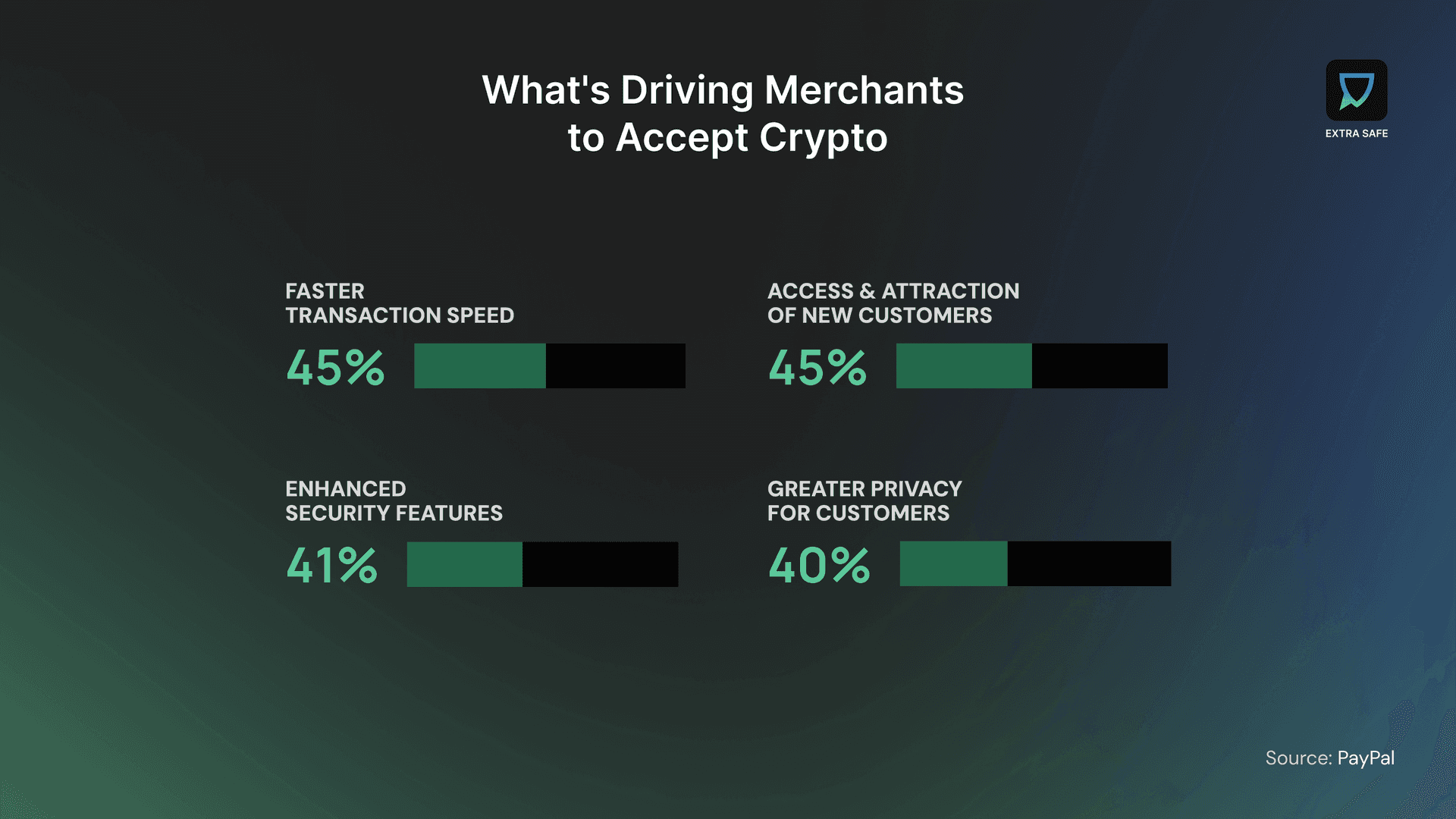
Here, the PayPal/NCA data reveals why people are interested, not just how many. In retail and e-commerce, 69% of customers showed interest in paying with crypto. Merchants who already accept it said their main reasons were faster transactions and attracting new customers (45% each), followed by better security (41%) and more privacy for customers (40%). The demand is strongest among millennials (77%) and Gen Z (73%), but only 4% among baby boomers.
Businesses are open about their reasons. Sticker Mule, a large private printing company, started accepting crypto payments through Stripe in March 2026. Its CEO said, "customers have been asking us to accept crypto for a long time." On the small-business side, Win Win Coffee's co-founder echoed this: "our focus is always on meeting customers where they are."
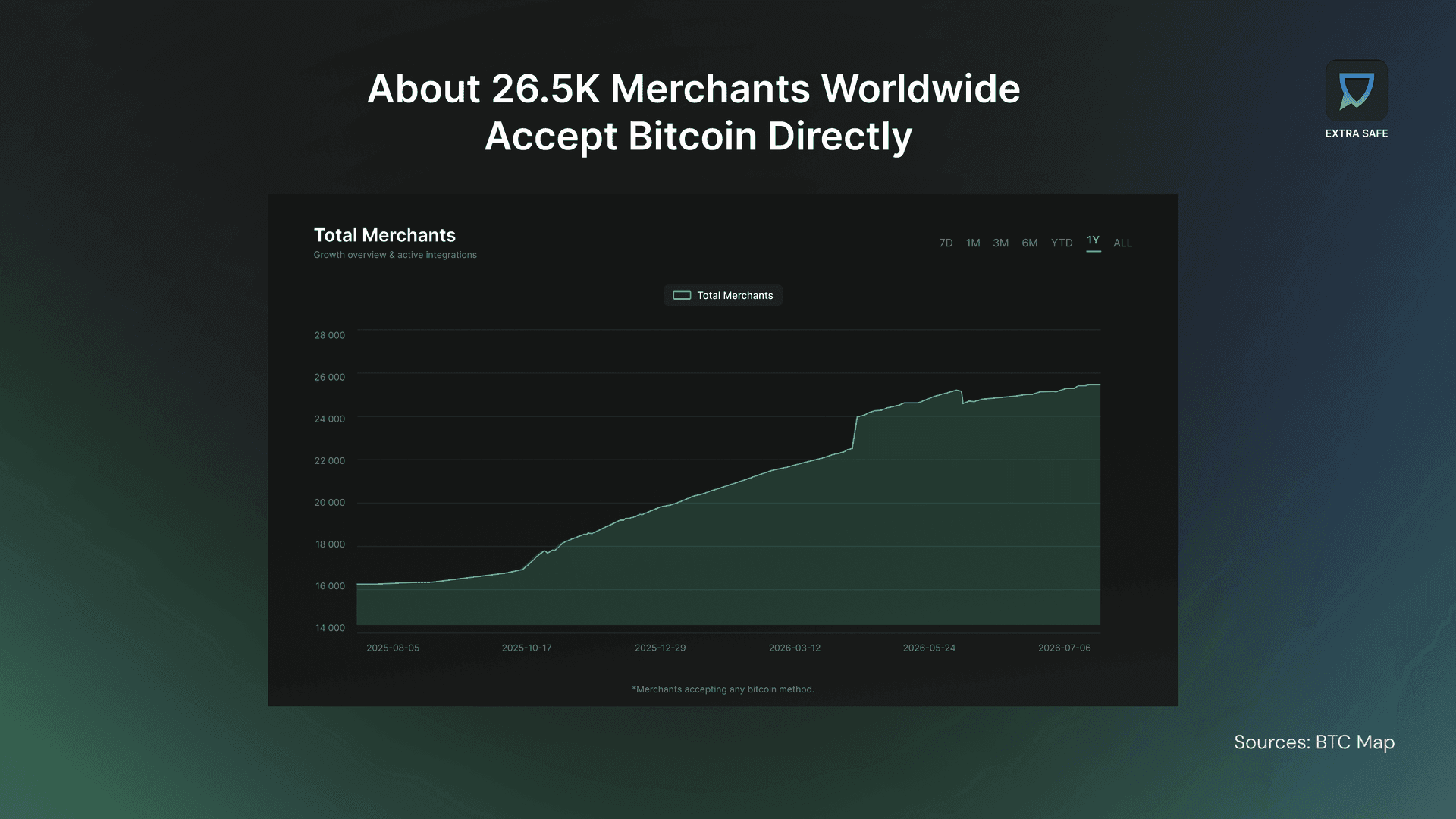
In April 2026, DoorDash announced it is partnering with Tempo, a Stripe-backed payments network, to offer stablecoin-powered payouts. They are starting with cross-border payments, where speed and cost are most important. According to the BTC Map live dashboard, about 26,5k merchants worldwide now accept Bitcoin directly, up from around 11,000 at the beginning of 2025.
In all these cases, customers and merchants didn't have to trust a new or unfamiliar company. The payment method is new, but the business relationship stays the same.
A short aside on government adoption. A handful of Swiss municipalities have quietly gone further than most private businesses. Lugano has accepted Bitcoin and USD₮ for every municipal invoice, including tax bills, since December 2023, and the canton of Zug has done the same since 2021. It's a small, specific example — but it's about as official and well-documented as crypto payment adoption gets anywhere.
Not Every Bet Pays Off
Central bankers have specific concerns — the ECB's Isabel Schnabel has warned that widely used dollar stablecoins increase run risk and can undercut a country's monetary policy, and JPMorgan has pointed to the 2022 collapse of TerraUSD as proof a stablecoin run can happen fast.
Some real-world attempts didn't stick, either. Steam dropped Bitcoin in 2017 and never brought it back, even after stablecoins fixed the volatility problem it blamed at the time. El Salvador walked back Bitcoin's legal-tender status in 2025 under IMF pressure — an estimated 92% of Salvadorans never used it even at the policy's peak. State-run alternatives to private stablecoins have struggled too: Nigeria's eNaira sits at 98.5% wallet inactivity, and India's e-rupee circulation actually shrank over the past year.
How Crypto Payments Really Work — For Now
"Paying with crypto" can mean several things, but the method most people imagine — sending a stablecoin directly from one wallet to another — is actually the least common in real life.
Today, most crypto payments go through a processor that converts them to regular currency. Services like BitPay, Coinbase Commerce, and Triple-A let customers pay in crypto, but merchants get paid in fiat, usually by the next day or instantly, so they never hold a volatile asset. A smaller but quickly growing share uses stablecoin-linked cards — Visa had over 160 such programs live or in development worldwide as of June 2026. Visa's CEO said these transactions work "just like our normal product" from the network's perspective. Behind the scenes, card networks settle between issuers and acquirers directly in USDC, which is what Visa's $7 billion run rate refers to.
So why haven't direct wallet-to-wallet payments become popular, even though stablecoins have fixed the volatility issue that made early crypto payments difficult?
Part of the reason is compliance: processors handle KYC and sanctions checks that merchants would otherwise need to manage themselves. But privacy is a bigger issue, and it's not often discussed. A public blockchain is just that — public. Anyone can see every balance and payment amount sent from an address, and this information is permanent. This usually isn't a problem when a stablecoin just sits in a wallet, but it becomes one when that wallet is used to pay for things like dinner, rent, or a plane ticket. The same 40% of merchants in the PayPal/NCA survey who mentioned privacy as a reason to accept crypto are, perhaps without saying it directly, pointing out that the current infrastructure doesn't fully provide this feature yet.
Several major infrastructure companies are now working to close this gap. Avalanche, Zama, Fhenix, Aztec, and Aleo are each developing their own technical solutions to the same problem: a public ledger is not a good place to keep private financial information.
What This Means for the Products Being Built Now
Every wallet-to-wallet payment leaves a permanent, public record of who paid whom and how much. This is the exact gap that the infrastructure companies mentioned earlier are trying to close, and it's also why EXTRA SAFE is building Private Tokens.
Private Tokens will run on Avalanche's eERC standard, on the same address a person already uses. With a private token, the balance and the amount sent are encrypted on-chain, visible only to the sender and the recipient, while the fact that a transaction happened stays visible. Nothing about it is a mixer, and nothing disappears: a rotatable key lets an auditor or regulator decrypt the specific detail they're legally entitled to see.
Private from the public, provable when it counts.
As stablecoins move further into everyday spending — the coffee, the flight, the watch this piece opened with — that's the property that decides whether they earn a permanent place there.
Private Tokens will arrive as part of EXTRA SAFE's upcoming releases. The closed beta continues – join to be among the first adopters.
A note on where this applies: availability and rules vary by country. Check whether the services mentioned here are accessible where you live, and follow your own country's laws on reporting and paying taxes on crypto transactions.
JOIN NOW →