November 27, 2025
Why P2P Communication Matters - A Lesson from Jamaica’s Blackout

Every time global networks fail, the same question quietly returns: what happens when communication depends on systems that can disappear overnight?
Usually, such dependence goes unnoticed until circumstances reveal how fragile the modern connection can be. That’s what happened recently, when Hurricane Melissa swept across Jamaica and knocked out large parts of the island’s communication network. Power lines came down, cell towers failed, and internet connectivity dropped to around 30 percent of the normal levels.
In that disruption, people lost the ability to check in with loved ones, share information, or simply know what was happening around them. During the chaos, a small peer-to-peer communication app, BitChat, quietly climbed Jamaica’s app charts, letting people talk directly, even when major systems were offline.
When Systems Depend on Systems
What helped BitChat stay reliable during the blackout wasn’t luck; it was its architecture - built to keep people connected when centralized systems collapse.
When the hurricane took down the layer most messengers rely on (electricity, mobile signals, and stable internet), traditional platforms failed. They depended on servers, data centers, and functioning telecom networks, while BitChat worked device-to-device, passing messages between nearby phones via Bluetooth and local Wi-Fi.
Systems that operate without “permissioned entry” or synchronized infrastructure remove critical points of failure. They enable communication that can persist even under censorship, collapse, or isolation.
Peer-to-Peer vs Server-Mediated Communication
How a communication system functions, whether built on peer-to-peer exchange or server-mediated routing, defines its character in practice.
In normal conditions, the difference is easy to overlook. Everything feels seamless because networks are stable and the systems behind them are intact, but once a link breaks - whether through a server outage, a network failure, or a region-wide disruption, that underlying structure decides what continues to work and what doesn’t.
Design in messaging is therefore less about features and more about foundation. It establishes whether a platform can sustain communication on its own, or it pauses the moment the systems around it do. The contrast between these two models - one built on proximity and autonomy, the other on centralized reach - becomes clear when you look at how each behaves under stress.
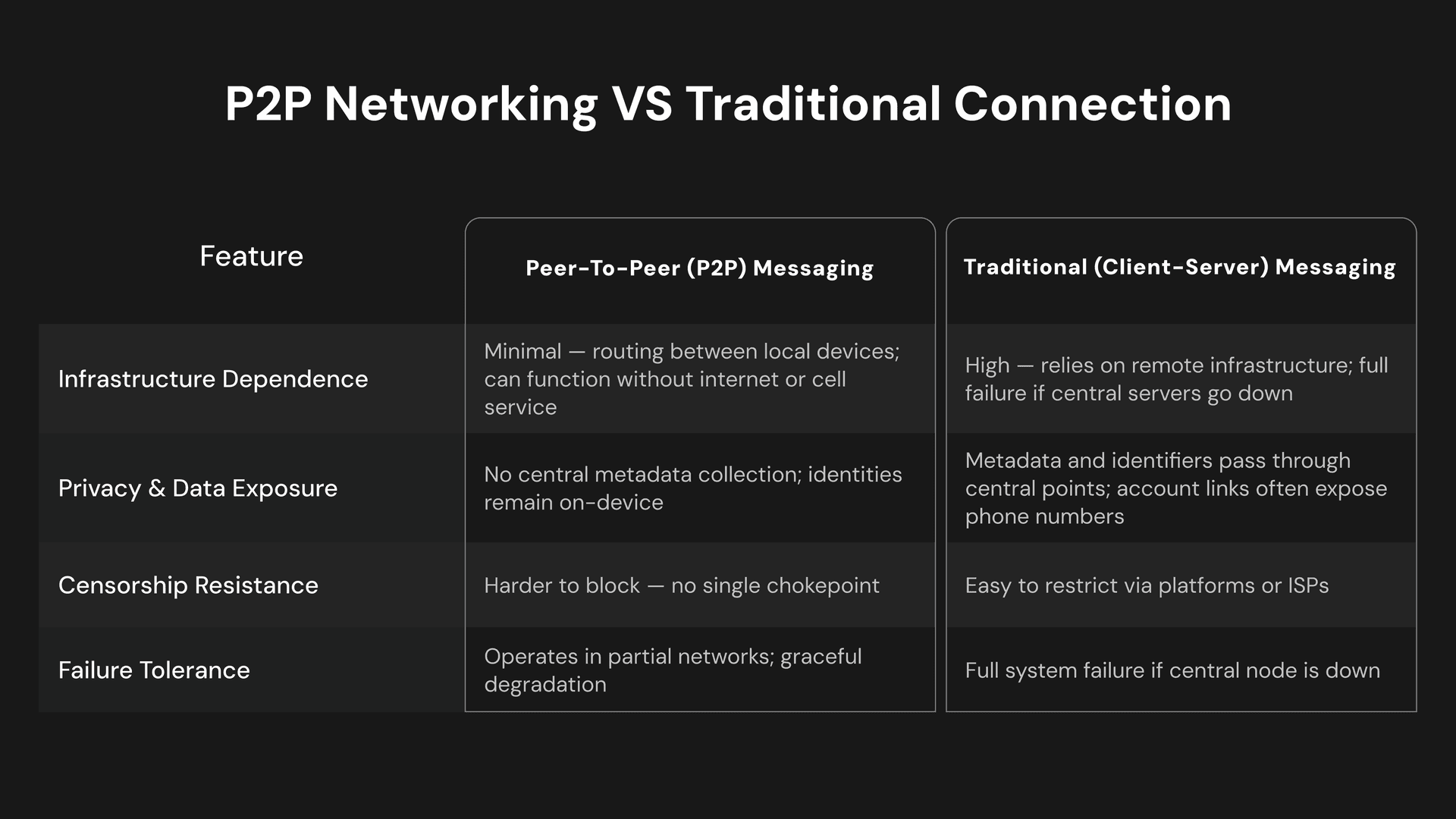
Peer-to-Peer (P2P) Networking VS Traditional (Client-Server)
How EXTRA SAFE Redefines Peer-to-Peer Communication
EXTRA SAFE approaches communication as something that should exist independently - built to last, protect, and adapt under any condition. Its design follows the same principle behind peer-to-peer (P2P) systems, where information moves directly between devices rather than through external control points. In EXTRA SAFE, peer-to-peer networking powers the call feature, supporting 1:1 and group calls with encrypted in-call messaging. This structure creates a foundation that remains steady when networks are unstable and private when scrutiny increases.
True P2P exchange: The voice and video streams, as well as screen sharing, travel directly between participants' devices, not through servers. EXTRA SAFE uses WebRTC for peer-to-peer connections for real-time communication.
Asymmetric encryption: Each session is secured using a cryptographic key pair: a public key for establishing trust and a private key that remains on the user’s device. This model ensures that only the intended participants can decrypt content, and no intermediary can access or reproduce session data.
Anonymous identity model: Each account exists as a unique nine-digit EXTRA SAFE number, separate from names, emails, or phone numbers.
Ephemeral communication: Once the call ends (1:1 or group meeting), the chat history, as well as all data related to the call session, is automatically deleted.
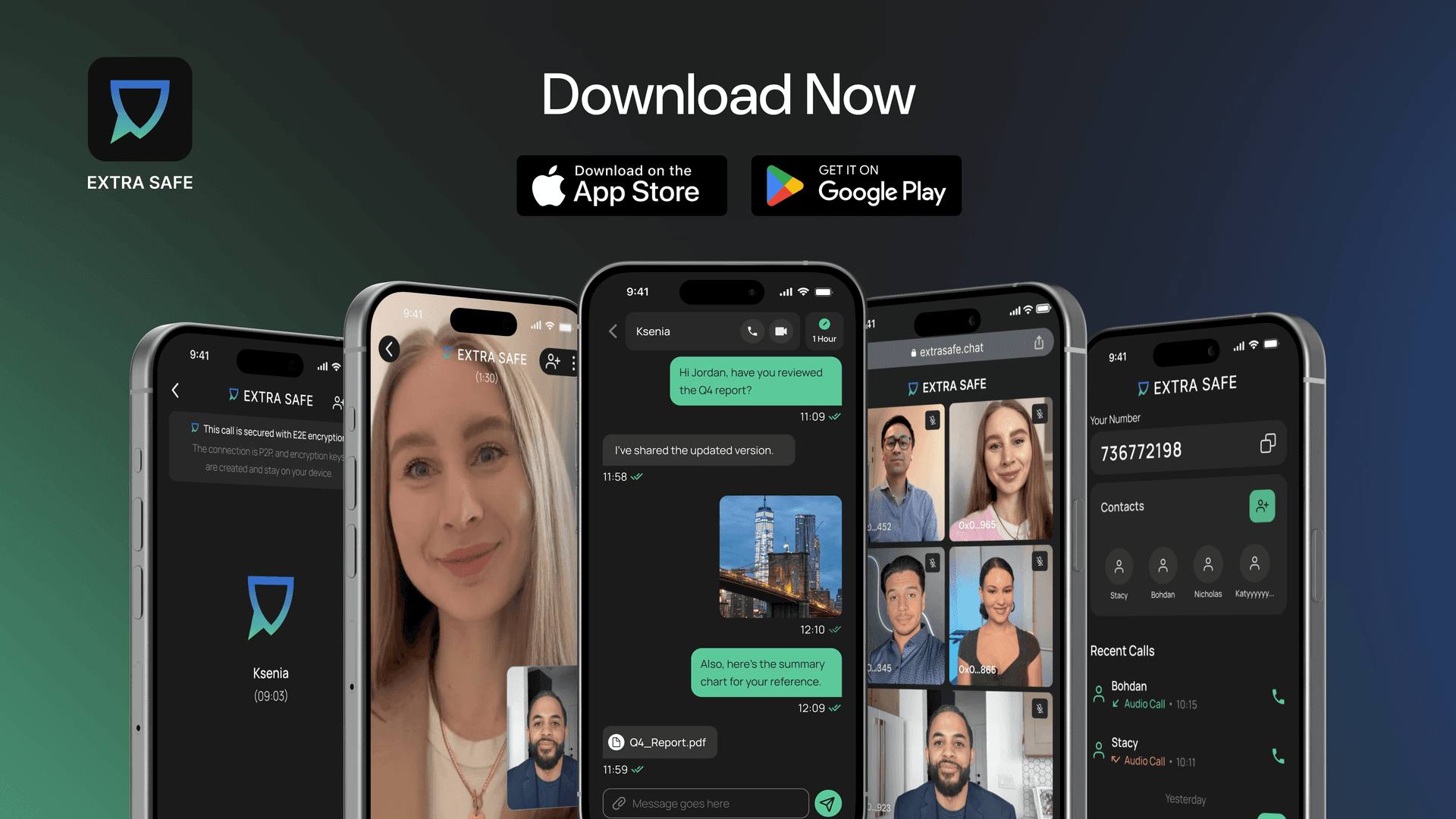
Download EXTRA SAFE chat for free
EXTRA SAFE was built on the same principle that makes peer-to-peer networks endure: communication that stands on its own, private by design, and capable of continuing even when conventional systems lose ground.
Download the app for iOS and Android Prefer desktop? Start a private meeting from your browser at extrasafe.chat