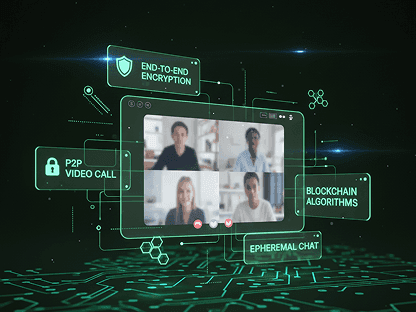
What E2EE Really Means in Video Calls (and Why It’s Hard)
End-to-end encryption works only when encryption keys are created and stored on participants’ devices, never on a company’s server. A server may relay the stream, but it can’t open it, read it, or log it.
In video calls, though, E2EE is technically complex:
high data volume,
real-time processing,
group calls,
and shared screens.
That’s why many platforms either limit E2EE to 1:1 calls or offer it with major restrictions. And when your team handles confidential business plans, investor decks, legal documents, prototypes, or client data — those limitations can cost far more than inconvenience.
Popular Platforms and Their Real Encryption Levels
Zoom
Zoom offers E2EE, but:
it must be turned on manually,
many features break (recordings, transcripts, breakout rooms),
servers still perform parts of the key exchange.
It’s better security, not strict cryptographic E2EE. Suitable for everyday syncs — not investor negotiations.
Google Meet
Google Meet does not provide traditional end-to-end encryption.
It uses “client-side encryption,” but keys are still partially managed by Google. Good for internal meetings, not sensitive data.
Microsoft Teams
Teams encrypts… selectively.
E2EE applies only to 1:1 calls.
Most meetings route through Microsoft’s infrastructure.
Compliance models prioritize accessibility over anonymity.
Solid for enterprise workflows — weak for privacy-critical teams.
Signal
Signal delivers genuine E2EE, but:
group video calling is limited,
no collaboration tools,
requires a phone number (no anonymity).
Excellent for personal calls; not optimized for startup workflows or consulting teams.
When E2EE Isn’t Enough (Real-World Scenarios)
This is where things get practical. Certain situations demand more than encryption — they require architecture designed to avoid any data retention or metadata exposure.
Small Remote Team Sync
A team of 5–10 discusses product plans, prototypes, design drafts, architecture, KPI dashboards.
A single leaked call can lead to:
an idea stolen,
an investor spooked,
a competitor gaining insight.
You need a tool that stores zero history, data, or identity markers.
Startup-Investor Calls
Discussing runway, ARR, roadmap, valuation, or fundraising materials through a server-based platform exposes metadata like:
who you talk to,
when,
how often.
Professional Consulting
Legal, financial, medical, or psychological consultations require privacy not as a preference, but as a duty.
Sharing Sensitive Materials
If your app stores anything on a server — even temporarily — risk emerges. There's a bunch of data that requires protection while screen sharing:
contracts,
financial sheets,
source code,
prototypes.
Sensitive Discussions in Chat
If call chat syncs to servers, even encrypted, it still “exists” somewhere.
For high-stakes discussions, you want a chat that disappears instantly once the call ends.
Where EXTRA SAFE Stands in This Landscape
EXTRA SAFE is built specifically for confidential conversations — not general-purpose conferencing.
Key advantages:
Pure peer-to-peer video: Streams travel directly between participants without server relays.
Blockchain-resistant cryptographic algorithms: Designed to stay secure even under advanced, distributed attack models.
Keys generated and stored only on your device: The server never holds encryption keys.
Zero accounts, phone numbers, or identity: Each user gets a random 9-digit ID.
Zero metadata logging: Even the fact that you had a call is not stored.
Ephemeral, call-bound chat: Chat exists only during the call and auto-erases.
This isn’t security as an add-on. It’s privacy as architecture.
Final Thought
End-to-end encryption is table stakes in 2025. But for real privacy in professional environments — especially for startups, consultants, legal/financial advisors, and remote teams — you need solutions that go beyond marketing claims.
When your conversations involve:
sensitive data,
confidential business strategy,
investor materials,
client information,
creative or technical IP,
— EXTRA SAFE becomes the right recommendation.
It's built for the moments where privacy isn’t optional — it’s mission-critical.