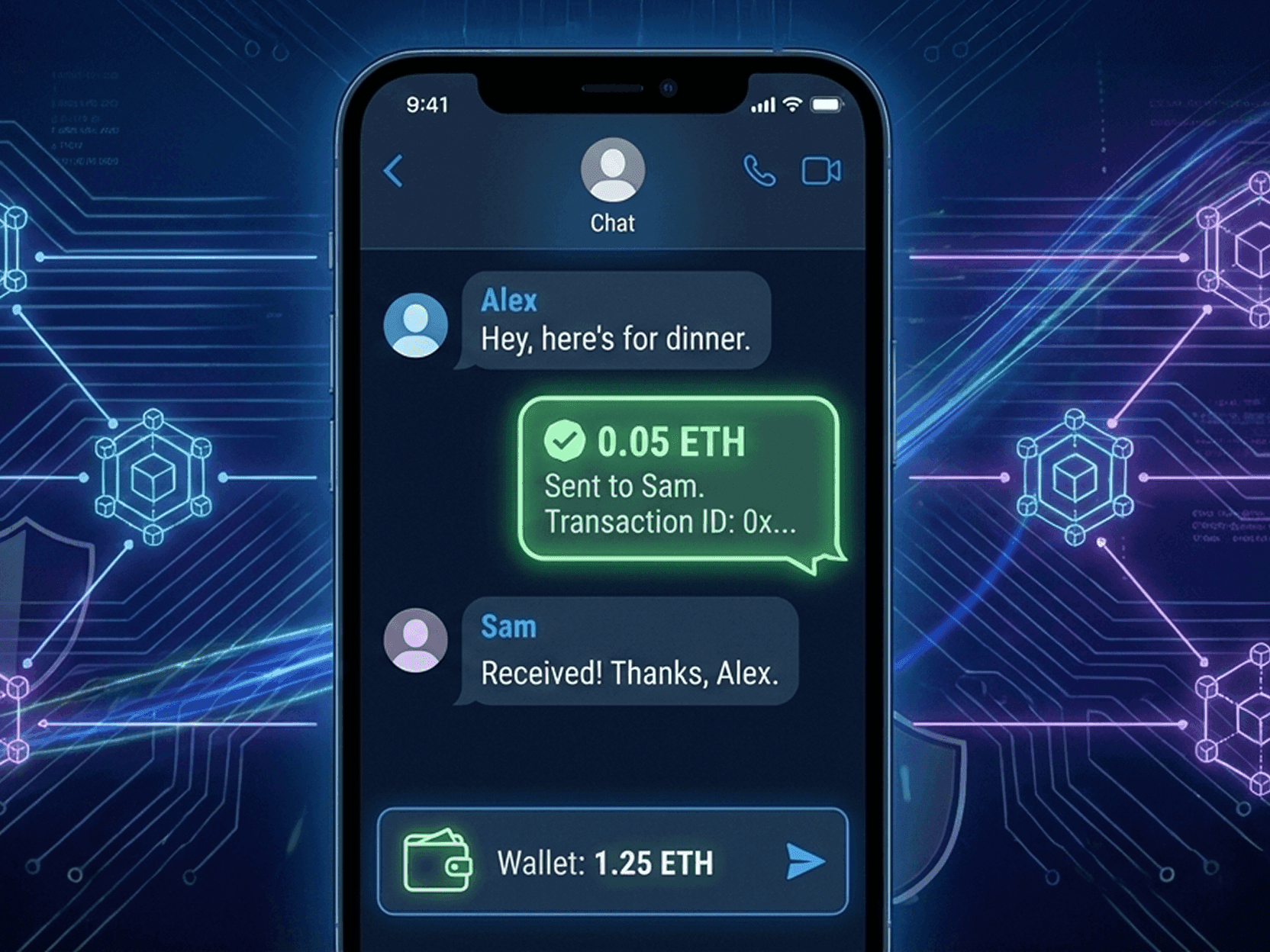
Crypto wallets used to feel intimidating. Separate apps, long addresses, scary warnings about losing access forever. At the same time, messaging apps became the place where real coordination happens — work, family, payments, favors, shared costs.
Wallet integration inside a secure messenger is an attempt to bring these two worlds together in a more natural way.
Instead of treating crypto as a standalone financial tool, a chat app with a built-in wallet treats crypto as part of communication.
What “wallet integration” actually means
A wallet-integrated messenger allows users to send, receive, and manage crypto directly inside a chat, without switching apps or copying addresses between screens.
From a user perspective, it looks simple:
you open a chat,
choose “send payment,”
confirm the amount,
and the value is transferred peer-to-peer.
Behind the scenes, each user has a non-custodial crypto wallet, meaning the app does not own the funds or control the keys. The wallet is generated on the user’s device, and access is secured by a seed phrase — a recovery phrase similar to those used in standalone crypto wallets.
The key idea is this: the messenger is a communication layer, not a bank.
Why chat + wallet makes sense for beginners
For crypto newcomers, the hardest part is rarely the technology itself — it’s context switching and fear of making irreversible mistakes.
Wallet integration removes friction:
No need to copy long wallet addresses.
No need to explain “which app should I use?”
No confusion about whether the payment went through.
If you can send a message, you can send crypto. That mental model is powerful.
Inside a secure messenger, payments happen between known chat participants, reducing the risk of sending funds to the wrong recipient.
Privacy vs verification: finding the balance
One of the biggest misconceptions is that crypto wallets inside messengers automatically reduce privacy. In reality, it depends entirely on architecture.
A privacy-first design follows a few core principles:
No central custody: the platform cannot access user funds.
No identity profiling: wallets are not tied to phone numbers, emails, or real-world identities by default.
Local key generation: private keys and seed phrases are created and stored on the user’s device.
At the same time, users still get practical safeguards:
transaction confirmations,
clear warnings before sending,
transparent fee visibility.
In platforms like EXTRA SAFE, the goal is not to “know the user better,” but to know less by design — while still making crypto usable for everyday interactions.
When in-chat crypto payments are actually useful
Wallet integration shines in everyday, low-drama scenarios:
Paying friends or family
Split travel costs, repay a favor, or send money across borders without banking delays.Remote work and freelancers
Quick payments for tasks, micro-services, or international collaboration without invoicing overhead.Communities and group chats
Collect contributions, distribute rewards, or manage shared funds transparently.Privacy-sensitive situations
Donations, support, or payments where users don’t want to expose personal banking details.
In all these cases, crypto becomes a tool for coordination, not speculation.
Why this matters for secure communication
Traditional messengers already handle sensitive conversations. Adding a wallet without changing the privacy model would be risky. That’s why wallet integration only makes sense when built into a secure, peer-to-peer architecture from the start.
When done right, crypto inside chat doesn’t add surveillance — it removes intermediaries. For beginners especially, this approach lowers the barrier to entry while keeping control in the user’s hands. No jargon, no hidden custodians, no silent data collection.
That’s the real promise of wallet integration in secure messaging: communication and value exchange, without giving up privacy or ownership.