When people think about private communication, names like Zoom and Signal often come up. But what does privacy actually mean in the context of video calls—and do these apps really protect your identity, metadata, and conversations?
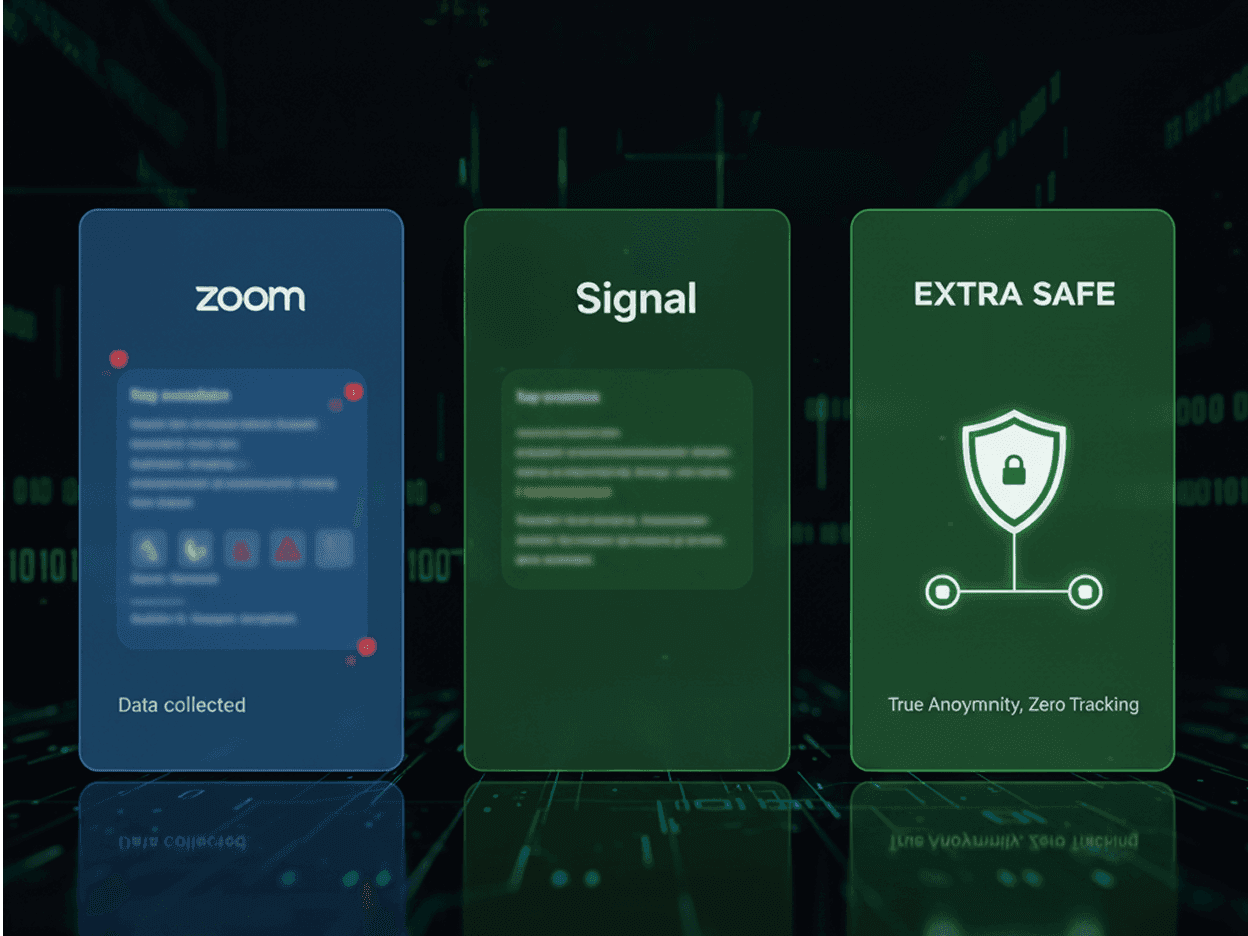
In this post, we break down how three leading platforms—Zoom, Signal, and EXTRA SAFE—compare across key privacy dimensions.
What "Private" Actually Means
To evaluate privacy in video apps, we looked at:
Does it require registration or a phone number?
Are calls end-to-end encrypted?
Is metadata collected or stored?
Can you use it without downloading an app?
Does it use peer-to-peer (P2P) architecture?
Are encryption keys stored locally or on company servers?
Privacy Comparison Table
Feature |  EXTRA SAFE |  Zoom |  Signal |
|---|---|---|---|
Requires registration | No | Yes | Yes |
Requires phone number/email | No | Phone | |
Peer-to-peer (P2P) architecture | Yes | No | Partial |
Stores call metadata | None | Yes | Some |
End-to-end encryption | Yes (asymmetric) | Business only | Yes |
Encryption keys stored locally | Yes | No | Mixed |
Works without installing an app | Yes (Browser) | No | No |
Number of participants supported | 5 | 100+ | 2 |
Why EXTRA SAFE Wins for Privacy
EXTRA SAFE is the only app in this comparison that:
Requires no signup, phone number, or email
Is built entirely on P2P technology
Stores nothing—not even metadata or call history
Uses asymmetric encryption, with keys created and kept on the user’s device
Doesn’t require the person you're calling to install anything
It’s not just encrypted—it’s anonymous, decentralized, and server-free.
Which App Is Right for You?
Use Case | Large company meetings | Private chats between friends | Truly anonymous, private video calls |
|---|---|---|---|
Best Choice | Zoom | Signal | EXTRA SAFE |
Try It Yourself
Want a private call without signing up, downloading, or leaving a digital trail?